


What is a tube-sheet heat exchanger that is fixed?
The tube bundle in a fixed tube sheet heat exchanger is firmly fastened to the shell on both ends and cannot be removed for external maintenance. The design is kept simple with this shell-and-tube arrangement; straight tubes run the entire length of the shell and are connected to stationary tube sheets that are welded straight to the shell wall. Two fixed tube sheets are connected at either end by straight tubes that extend the entire length of the shell. Compared to removable-bundle designs like floating head or U-tube types, permanent tube sheet exchangers are easier, lighter, and more affordable to manufacture. However, they are best suited for clean, non-fouling fluid services where only chemical cleaning is necessary and thermal expansion between shell and tubes is modest because the bundle is inaccessible.
Fixed Tube Sheet Heat Exchanger: How the Heat Transfer Works
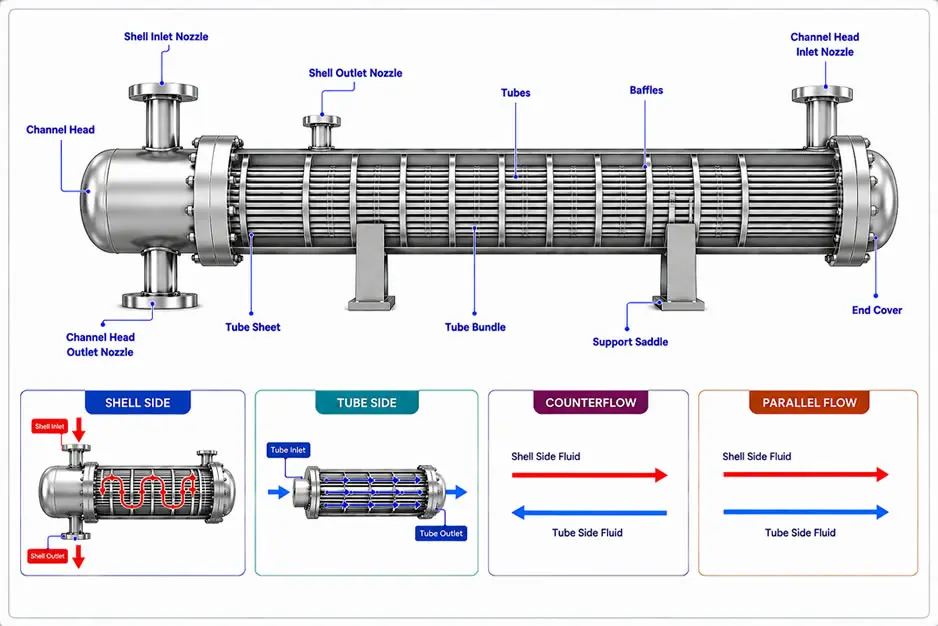
Inside a fixed tube sheet unit, two fluids never touch, yet heat still passes between them through a simple two-path system:
- The outer path (shell side) carries one fluid around the outside of the tube bundle. Baffles inside the shell often force this fluid into a zigzag or helical route rather than a straight line, which increases contact time with the tubes and improves heat pickup or release.
- The inner path (tube side) carries the second fluid straight through the tube bundle itself. Depending on how the exchanger is set up, this stream can run alongside the shell-side flow or head in the opposite direction.
- Where the heat actually crosses over: the tube walls form the boundary. Heat moves from whichever fluid is hotter, through the metal wall, into whichever fluid is cooler — the tube sheets seal each stream into its own channel so they never mix, even as heat passes freely between them.
- Counterflow sends the fluids in opposite directions, keeping the temperature gap between them wider for longer and pulling more heat across in the process.
- Parallel flow sends both fluids the same direction. The temperature difference shrinks fast, so it transfers less heat overall — but it's still the right call for some process setups where gentler, more even heating is the goal.
Fixed Tube Sheet Design Considerations
Achieving optimal performance from a fixed tube sheet exchanger relies on a few key design choices made prior to fabrication, rather than on post-fabrication adjustments.
Tube Pitch and Pattern
Tubes are arranged in either a triangular pattern or a square pattern across the tube sheet. Triangular pitch packs more tubes into the same shell diameter, providing a greater surface area for heat transfer per unit volume—the standard choice for clean, non-fouling shell-side fluids. Square pitch leaves straight lanes between tube rows, which allows mechanical cleaning lances to pass through the shell side—necessary when the shell-side fluid has fouling potential even though the bundle itself can't be pulled.
Baffle Spacing
Baffles do more than direct flow—spacing them closer together increases shell-side velocity and turbulence, improving heat transfer, but also increases pressure drop and pumping cost. Wider spacing reduces pressure drop but risks dead zones and lower film coefficients. The right spacing balances thermal performance against the allowable pressure drop for the specific process.
Pass Arrangement
Fixed tube sheet units can be built as single-pass (fluid travels the tube length once) or multi-pass (fluid is routed back and forth through the tube bundle via pass partition plates in the channel head). Multi-pass designs increase tube-side velocity and heat transfer coefficient for a given tube count but add complexity and pressure drop. Two-pass and four-pass configurations are the most common in industrial service.
Materials of Construction for Fixed Tube Sheet Exchangers
Material selection is driven by the corrosivity of both fluids, operating temperature, and required service life—not just cost.
- Carbon Steel: The most economical option for non-corrosive services like steam, cooling water, and general utility duties.
- Stainless Steel 304/316: Standard choice where corrosion resistance and hygiene matter—chemical processing, pharmaceutical, and food-grade applications.
- Titanium: Selected for seawater cooling and highly aggressive chloride environments where even 316 stainless would degrade over time.
- Duplex Stainless Steel: Combines high mechanical strength with strong resistance to chloride stress corrosion cracking—used in offshore and demanding chemical service.
- Copper Alloys: Chosen for their high thermal conductivity in HVAC and refrigeration duties where corrosion resistance requirements are moderate.
- Hastelloy: Reserved for the most chemically aggressive and high-temperature services where standard stainless grades cannot survive long-term.
United Cooling Systems selects and confirms material specification with the client at the design stage, matched to actual fluid chemistry and operating conditions rather than a generic default.
Advantages of Fixed Tube Sheet Heat Exchangers
- Durability and Reliability: Fixed tube sheet heat exchangers are known for their robustness and ability to handle high pressures and temperatures. They are built to last and can withstand harsh operational conditions.
- Simplicity of Design: The construction of a fixed tube sheet heat exchanger is relatively simple, making it easier to manufacture and maintain. The fixed tubes provide greater structural integrity than designs with floating tube sheets.
- Low Maintenance: Since the tube bundle is fixed and doesn’t move, these heat exchangers require less maintenance. The tubes are held in place firmly, minimizing the chance of vibration or mechanical failure.
- Compact Design: These heat exchangers are available in a compact design, which is beneficial for industries where space is a constraint.
- Cost-Effectiveness: Due to their simple design, fixed tube sheet heat exchangers are more affordable compared to other heat exchanger types like floating head or U-tube heat exchangers.
- Corrosion Resistance: Many fixed tube sheet heat exchangers are constructed with corrosion-resistant materials such as stainless steel, ensuring long-term performance in various applications.
Applications of Fixed Tube Sheet Heat Exchangers
Fixed tube sheet heat exchangers are versatile and used in numerous industries. Some common applications include:
- Oil & Gas Industry: In the oil and gas sector, fixed tube sheet heat exchangers are commonly used to cool or heat fluids during extraction, refining, and transportation processes.
- Power Generation: They are used in power plants for cooling water and condensers, particularly in systems that require consistent heat transfer.
- Chemical Industry: In chemical manufacturing, these heat exchangers help control the temperature of reactive fluids and maintain precise conditions in reactors and mixers.
- Food & Beverage Industry: Fixed tube sheet heat exchangers are used for pasteurization, sterilization, and cooling processes in the food and beverage sector.
- HVAC Systems: They are commonly used in large heating, ventilation, and air conditioning (HVAC) systems for heat exchange between water and air or water and refrigerant.
- Pharmaceutical Industry: Fixed tube sheet heat exchangers are used in various pharmaceutical applications, such as cooling pharmaceutical products or in the distillation process.
Fixed Tube Sheet vs Floating Tube Sheet
| Feature | Fixed Tube Sheet | Floating Tube Sheet |
|---|---|---|
| Design | Both ends welded, rigid | One end floats freely |
| Thermal Expansion | Requires expansion joint above 50°C differential | Absorbs expansion independently |
| Cost | Lower, simpler | Higher, more complex |
| Cleaning | Tube-side mechanical, shell-side chemical | Full bundle removable for cleaning |
| Best For | Clean shell-side fluids | High-temperature, high-fouling service |
Fixed Tube Sheet vs U-Tube Heat Exchanger
| Feature | Fixed Tube Sheet | U-Tube |
|---|---|---|
| Tube Shape | Straight, full length | Bent into U-shape, one tube sheet only |
| Thermal Expansion | Requires expansion joint above 50°C differential | U-bend absorbs expansion naturally, no joint needed |
| Tube-Side Cleaning | Full mechanical cleaning — straight-through access | Mechanical cleaning blocked at the U-bend |
| Tube Pass Configuration | Any number of passes | Limited to even numbers of passes |
| Individual Tube Replacement | Straightforward for outer tubes | Innermost tubes are very difficult to replace |
| Best For | Clean fluids needing tube-side mechanical cleaning | High-pressure, high-temperature clean services with large expansion differentials |
Fixed Tube Sheet Heat Exchanger Maintenance
Proper maintenance is crucial to ensure the longevity and efficiency of fixed tube sheet heat exchangers. Here are a few key maintenance tips:
- Regular Cleaning: Over time, deposits may accumulate on the heat transfer surfaces, reducing the efficiency of heat exchange. Regular cleaning of the tubes and shell is necessary, especially in applications involving dirty or fouling fluids.
- Inspect for Leaks: Periodically inspect the heat exchanger for any leaks in the tube bundle or shell. Any fluid leaks can affect the performance of the heat exchanger and may lead to contamination.
- Monitor Fluid Flow Rates: Ensure that the flow rates of both the hot and cold fluids are within the recommended limits. Excessive flow can cause turbulence and reduce heat transfer efficiency.
- Check for Corrosion: The materials used in heat exchangers should be resistant to corrosion. However, it's essential to check for signs of corrosion, particularly in aggressive fluid conditions. If corrosion is detected, the affected parts should be replaced promptly.
- Pressure Testing: Perform regular pressure testing to ensure that the heat exchanger can withstand the required operating pressures. This is especially important in high-pressure applications to avoid the risk of failure.
Signs Your Fixed Tube Sheet Heat Exchanger Needs Replacement
Because the bundle can't be pulled for internal shell-side inspection, catching early warning signs matters more with fixed tube sheet units than with removable-bundle designs.
- Declining heat transfer performance: A gradual drop in outlet temperature difference despite unchanged flow rates usually points to fouling or scale buildup that chemical cleaning is no longer resolving.
- Rising pressure drop: An increasing pressure drop across the tube side, without a corresponding change in flow rate, signals internal blockage or tube fouling.
- Visible external corrosion or pitting: Corrosion on the shell exterior or around nozzle welds often indicates internal degradation has already progressed further than what's visible.
- Recurring tube leaks: Individual tube failures can sometimes be plugged, but frequent, repeated leaks across different tubes usually mean the bundle has reached the end of its practical service life.
- Failed hydrostatic test: An exchanger that no longer holds its rated test pressure has a structural integrity issue that plugging or patching won't reliably fix long-term.
Most of these issues develop gradually, which is why the pressure drop and inspection routines covered in the maintenance section above matter—catching decline early is far cheaper than an unplanned failure.
Understanding Expansion Joints in Fixed Tube Sheet Exchangers
Because both tube sheets are permanently welded to the shell, a fixed tube sheet exchanger has no built-in way to absorb the difference in how much the shell and tubes expand when heated. If the shell-side and tube-side fluids operate at significantly different temperatures, the tubes and shell try to expand by different amounts—and without somewhere for that difference to go, the stress transfers directly onto the tube-to-tubesheet welds and the tube sheet itself.
An expansion joint (also called a bellows) is a flexible, corrugated section built into the shell. It compresses or stretches slightly as the shell expands or contracts relative to the tubes, absorbing the differential movement before it can stress the welded joints.
As a general rule, an expansion joint becomes necessary once the temperature differential between shell-side and tube-side fluids exceeds roughly 50°C—though the exact threshold depends on tube material, tube length, and the specific thermal expansion coefficients involved. Below that threshold, the tube material itself typically has enough flexibility to absorb the differential without added hardware. United Cooling Systems calculates this requirement during the design phase based on your actual process temperatures, rather than applying a blanket rule to every unit.
Frequently Asked Questions
1. What's the biggest drawback of a fixed tube sheet heat exchanger?
The shell-side surface of the tubes can't be mechanically cleaned, since the tube bundle is permanently welded to the shell on both ends. This makes fixed tube sheet units best suited for shell-side fluids that are clean and non-fouling or for services where chemical cleaning alone is enough to keep the exchanger performing.
2. What makes a fixed tube sheet design a better choice than U-tube or floating head types?
It's the most compact and cost-effective shell-and-tube configuration available. A fixed tube sheet design packs more tubes into the same shell diameter than U-tube or floating head units, cuts manufacturing costs, and removes the need for shell-side gasketed joints—which means fewer potential leak points over the exchanger's service life.
3. How does a fixed tube sheet heat exchanger differ from a floating-head heat exchanger?
The tube bundle is fixed and non-removable in a tube sheet design, since both tube sheets are welded directly to the shell. A floating-head exchanger, by contrast, leaves one tube sheet free to slide within the shell, so the whole tube bundle can be withdrawn for full external cleaning and inspection.
4. When does a fixed tube sheet design make more sense than a U-tube exchanger?
Choose a fixed tube sheet exchanger whenever the tube-side fluid needs regular mechanical cleaning. Straight tubes can be rodded or jetted clean from end to end, while a U-tube design blocks that access entirely—the bend at the tube's midpoint prevents any cleaning tool from passing through.
5. Which TEMA standards cover fixed tube sheet heat exchangers?
Fixed tube sheet units can be built to TEMA Class R, B, or C, depending on how demanding the service is. United Cooling Systems manufactures across all three TEMA classes, matching the construction standard to your plant's specific pressure, temperature, and reliability requirements.
6. Are fixed tube sheet heat exchangers suitable for high-pressure applications?
Yes—the fully welded construction makes this one of the strongest shell-and-tube configurations for high-pressure service. United Cooling Systems engineers fixed tube sheet exchangers for high-pressure industrial duty in accordance with recognized pressure vessel design codes.
Conclusion
The fixed tube sheet heat exchanger
Request a Fixed Tube Sheet Heat Exchanger Quote


