

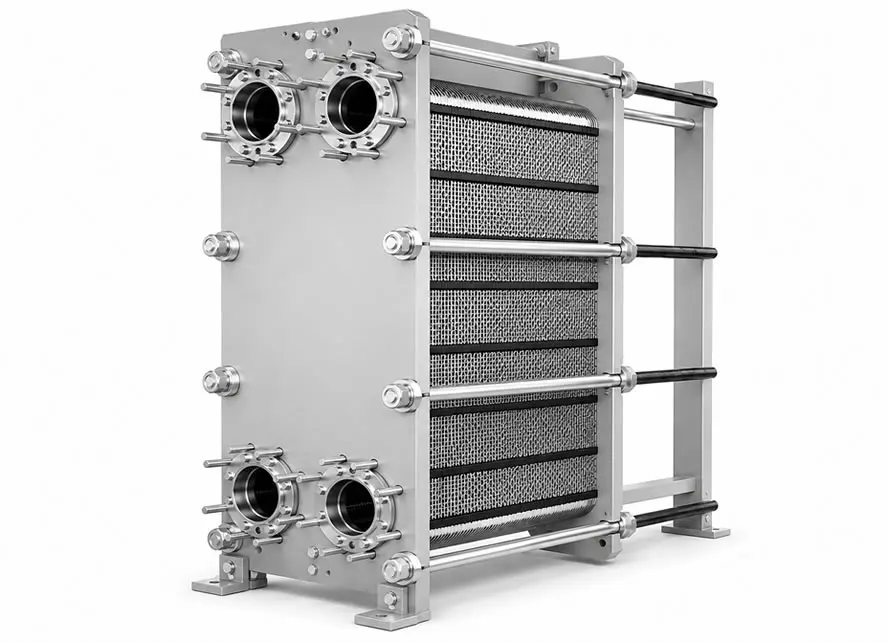
Plate heat exchangers are among the most efficient and widely used heat transfer devices in modern industry. From HVAC systems in office buildings to pasteurization lines in dairy plants, these compact units quietly do the job of transferring heat between two fluids without letting them mix. This guide covers everything you need to know—how they work, how they're built, the different types available, where they're used, their benefits and limitations, and how to keep them running efficiently for years.
What does a plate heat exchanger do?
A plate heat exchanger (PHE) is a device that transfers heat between two fluids using a series of thin, corrugated metal plates instead of the tubes and shells found in traditional heat exchangers. Each plate is separated by a small gap through which fluid flows, and the plates are stacked together so that hot fluid flows through alternating channels while cold fluid flows through the channels in between.
Because the fluids never physically mix, a plate heat exchanger can transfer heat efficiently while keeping the two fluid streams completely separate. This makes it ideal for applications where hygiene, purity, or chemical separation is critical—such as food processing, pharmaceuticals, and district heating.
Plate heat exchangers were first developed in the late 1800s and became commercially significant in the dairy industry during the early 20th century, where their compact size and ease of cleaning made them a major upgrade over older shell-and-tube designs. Today, they are used across nearly every industry that requires heating, cooling, or heat recovery.
The biggest reason for their popularity is simple: plate heat exchangers deliver more heat transfer per unit of space than almost any other exchanger design, while also being easier to inspect, clean, and expand as capacity needs grow.
How Does a Plate Heat Exchanger Work? Working Principle Explained
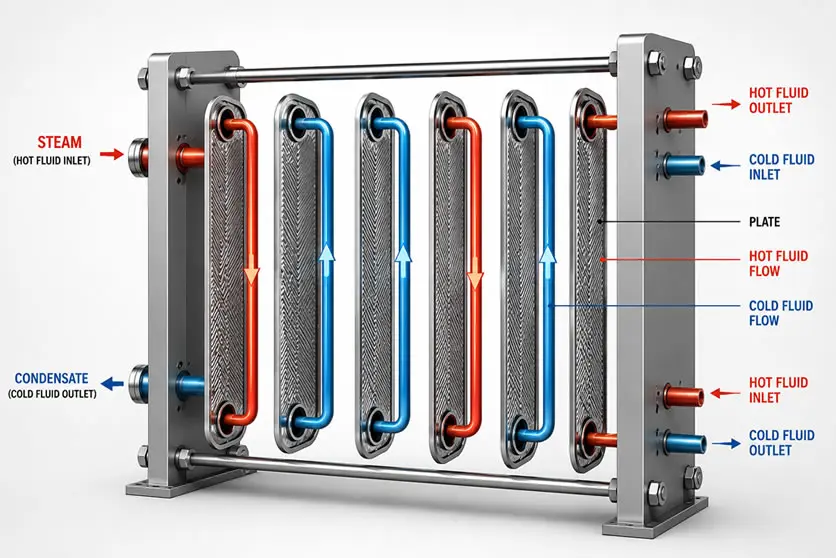
The working principle of a plate heat exchanger is based on maximizing surface area contact and turbulence within a compact footprint.
Step-by-step process:- Hot fluid enters through a port and is directed into alternating channels between the plates.
- Cold fluid enters through a separate port and flows through the neighboring channels, running in the opposite direction (counterflow) for maximum efficiency.
- Heat passes through the thin plate walls from the hot fluid to the cold fluid.
- The corrugated (wavy or herringbone) pattern pressed into each plate forces the fluid to move in a turbulent, swirling pattern rather than flowing in a smooth, straight line.
This turbulence is the key to the efficiency of a plate heat exchanger. In a straight, laminar flow, a thin layer of stagnant fluid clings to the plate surface and slows down heat transfer. The corrugated design constantly breaks up this boundary layer, keeping fresh fluid in contact with the plate surface at all times. As a result, plate heat exchangers achieve significantly higher heat transfer coefficients than shell-and-tube designs, often allowing a much smaller unit to do the same job.
Most industrial plate heat exchangers use a counterflow arrangement, where hot and cold fluids move in opposite directions. This creates a more consistent temperature difference across the entire plate length, allowing for a closer temperature approach and better overall efficiency compared to parallel flow, where both fluids move in the same direction.
Plate Heat Exchanger Design: Materials, Gaskets & Flow Arrangement
The performance and lifespan of a plate heat exchanger depend heavily on its design and material selection.
Plate materials: Plates are typically made from thin sheets of corrosion-resistant metal, pressed into a corrugated pattern. Common materials include:- Stainless steel (304 or 316) — the most common choice, offering good corrosion resistance and cost-effectiveness for general industrial use.
- Titanium — used for seawater cooling and highly corrosive applications, especially in marine and chemical industries.
- Nickel alloys (Hastelloy, Incoloy) — used for aggressive chemical processes where standard stainless steel would corrode quickly.
- Nitrile rubber (NBR) — general-purpose, cost-effective.
- EPDM — good for water and steam applications.
- Viton (FKM) — used for high-temperature or chemically aggressive fluids.
Gasket material selection depends on the operating temperature, pressure, and the chemical compatibility of the fluids involved.
Frame and construction The plates are held together within a frame consisting of a fixed head, a movable pressure plate, carrying bars, and tightening bolts. This frame allows plates to be added or removed, making capacity adjustments straightforward compared to fixed shell-and-tube units.
Flow arrangement As discussed earlier, counterflow is the standard configuration for most applications because it maximizes the temperature difference across the plate area. Parallel flow is occasionally used in specific process conditions where a more moderate, controlled temperature change is required.
Types of Plate Heat Exchangers: Gasketed vs Brazed vs Welded vs Semi-Welded
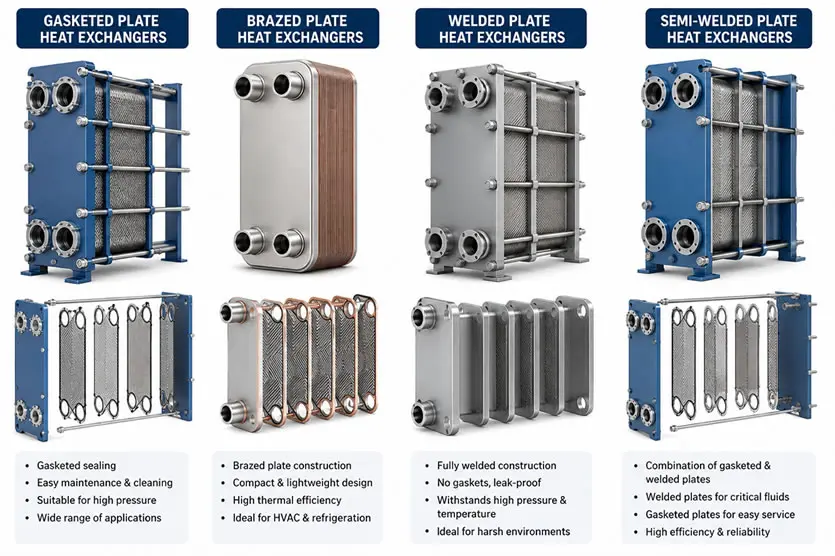
Not all plate heat exchangers are built the same way. The four major types differ mainly in how the plates are joined together, which affects maintenance access, pressure/temperature limits, and cost.
1. Gasketed Plate Heat Exchangers
The most common and versatile type. Plates are held together with gaskets and a bolted frame, allowing the unit to be opened for cleaning, inspection, or plate replacement. Ideal for applications requiring frequent maintenance, such as food and beverage processing.
2. Brazed Plate Heat Exchangers
Plates are permanently joined using a brazing material (typically copper or nickel) instead of gaskets. This creates a compact, leak-resistant unit that can handle higher pressures and temperatures. However, because it cannot be opened, it's best suited for cleaner fluids where fouling is minimal—such as refrigeration and HVAC systems.
3. Welded Plate Heat Exchangers
Plates are welded together, either partially or fully, eliminating gaskets in the areas exposed to aggressive or high-temperature fluids. This makes welded units suitable for handling corrosive chemicals, high-pressure steam, or extreme temperatures where gasket materials would fail.
4. Semi-Welded Plate Heat Exchangers
A hybrid design where one fluid channel is welded (for handling aggressive or hazardous fluids) while the other channel remains gasketed (allowing periodic cleaning). This design is common in refrigeration systems using ammonia or other hazardous refrigerants.
Top Industrial Applications of Plate Heat Exchangers (HVAC, Food, Power & Marine)
Plate heat exchangers are used across a wide range of industries due to their efficiency, compact footprint, and adaptability:
- HVAC systems — used in district heating/cooling networks, chillers, and building heat recovery systems to transfer heat between water loops efficiently.
- Food and beverage processing — critical for pasteurization of milk, juice, and beer, as well as sterilization processes where hygiene and precise temperature control matter.
- Chemical and petrochemical plants — used for process heating and cooling, often with corrosion-resistant materials to handle aggressive chemicals.
- Power generation — used in cooling systems for turbines, generators, and auxiliary equipment, as well as in geothermal and solar thermal plants.
- Marine and offshore systems — used for engine cooling, freshwater generation, and HVAC on ships, typically with titanium plates to resist seawater corrosion.
- Pharmaceuticals Pharmaceuticals—used in sterile processing where precise, contamination-free temperature control is essential.
The common thread across all these applications is the need for efficient, space-saving heat transfer combined with reliable performance under varying fluid conditions.
Benefits of Plate Heat Exchangers: Why Industries Prefer Them Over Shell & Tube
Compared to traditional Shell and Tube Heat Exchanger , plate heat exchangers offer several distinct advantages:
- High thermal efficiency — the turbulent flow pattern and large surface-area-to-volume ratio allow for closer temperature approaches and better heat recovery.
- Compact footprint — a plate heat exchanger can achieve the same heat transfer capacity as a shell-and-tube unit in a fraction of the space, which is especially valuable in retrofits or space-constrained facilities.
- Easy maintenance and inspection — gasketed units can be opened, cleaned, and inspected without specialized tools, reducing downtime.
- Scalability — capacity can be increased or decreased simply by adding or removing plates, without replacing the entire unit.
- Lower fluid volume — less fluid is held within the exchanger at any given time, which reduces startup time and improves temperature control responsiveness.
- Cost-effective for many applications — lower material usage per unit of heat transfer often makes plate heat exchangers more economical than shell-and-tube alternatives of comparable capacity.
Maintenance Guide for Plate Heat Exchangers
Regular maintenance is essential to keep a plate heat exchanger performing at peak efficiency and to avoid unplanned downtime.
Cleaning methods- CIP (Clean-in-Place): A chemical cleaning solution is circulated through the exchanger without disassembly. This is the standard method for food, beverage, and pharmaceutical applications where hygiene is critical and frequent cleaning is required.
- Manual cleaning: For gasketed units, plates can be physically removed, brushed, and rinsed to remove scale, biofilm, or particulate buildup. This method allows for a thorough visual inspection of plates and gaskets simultaneously.
- Chemical descaling: Acidic or alkaline cleaning agents can be used to dissolve mineral scale buildup, particularly in hard-water applications.
Gasket replacement: Gaskets should be inspected during every major service interval for signs of hardening, cracking, or compression set. Most manufacturers recommend replacing gaskets every 3–5 years, though this varies based on operating temperature, chemical exposure, and duty cycle.
Leak detection: Visible fluid leaking at the frame edges, abrupt pressure decreases, or cross-contamination between the hot and cold fluid circuits are typical indicators of gasket or plate failure. Regular pressure testing and visual inspections during scheduled shutdowns help catch these issues early, before they cause process contamination or costly downtime.
Preventive maintenance schedule: A good rule of thumb is to inspect gaskets and plates annually, perform CIP cleaning based on fouling rate (ranging from daily to quarterly depending on the application), and conduct a full teardown inspection every few years or whenever performance drops noticeably.
Frequently Asked Questions (FAQ)
1. What is the main difference between a plate heat exchanger and a shell-and-tube heat exchanger?
A plate heat exchanger uses stacked corrugated plates to transfer heat, offering higher efficiency and a smaller footprint. A shell-and-tube exchanger uses tubes inside a cylindrical shell and is generally more tolerant of high pressures and fouling fluids but is bulkier and less thermally efficient per unit of space.
2. How long do plate heat exchangers last?
With proper maintenance, plate heat exchanger frames can last 20–30 years, while gaskets typically need replacement every 3–5 years and plates may need replacement or re-corrugation over a similar timeframe depending on fluid conditions.
3.Can high-pressure applications be handled by plate heat exchangers?
Yes, though gasketed units have lower pressure limits than welded or brazed designs. For high-pressure steam or process fluids, welded or semi-welded plate heat exchangers are typically the better choice.
4. Why do plate heat exchangers use counterflow instead of parallel flow?
Counterflow keeps the temperature difference between the two fluids more consistent across the length of the plate, allowing for more efficient heat transfer and a closer temperature approach than parallel flow.
5. How often should a plate heat exchanger be cleaned?
Certain food processing machines need daily CIP cleaning, yet clean HVAC water loops could just need yearly inspection and cleaning. This all depends on the fluid and application.
6. Are plate heat exchangers suitable for viscous fluids?
Standard designs work best with low- to medium- viscosity fluids. For thicker or particulate-laden fluids, wide-gap plate designs are available to reduce clogging risk.
Conclusion & Future Trends
Plate heat exchangers have earned their place as one of the most efficient and versatile heat transfer solutions across industries, thanks to their compact design, high thermal efficiency, and ease of maintenance. While they do have limitations—such as pressure drop, gasket wear, and fouling sensitivity—these can largely be managed through proper design selection, material choice, and a consistent maintenance schedule.
Looking ahead, the industry is moving toward smarter, more sustainable plate heat exchanger systems. Innovations in plate geometry are improving turbulence and reducing pressure drop simultaneously, while new gasket materials are extending service life under more extreme conditions. Perhaps most significantly, digital monitoring and IoT-enabled sensors are now being integrated into plate heat exchangers to track fouling rates, predict maintenance needs, and optimize performance in real time—aligning with broader Industry 4.0 trends toward predictive maintenance and energy efficiency.
As industries continue to prioritize energy savings and sustainability, plate heat exchangers are well-positioned to remain a core technology for efficient thermal management for decades to come.


