


Marine engines run in one of the harshest thermal environments there is—constant vibration, saltwater exposure, and zero tolerance for cooling failure hundreds of miles from shore. A marine heat exchanger is built specifically for that reality, transferring heat from engine coolant, lubricating oil, or charged air to raw seawater or a secondary freshwater loop, all while withstanding relentless corrosion and continuous duty cycles.
At United Cooling Systems every marine heat exchanger is engineered around the specific demands of shipboard operation—not adapted from a land-based design. That means corrosion-resistant materials like cupro-nickel and marine-grade stainless steel, compact footprints for tight engine rooms, and construction that holds up to years of continuous seawater contact without failure. Whether cooling main propulsion engines, generators, or auxiliary systems, these units are built to keep vessels running reliably, voyage after voyage, in conditions where a cooling failure simply isn't an option.
How Does a Marine Heat Exchanger Work?
- Core Principle: A marine heat exchanger transfers heat between two fluids—typically engine coolant and seawater—without letting them physically mix, using a thermally conductive barrier like tubes or plates to allow efficient energy transfer.
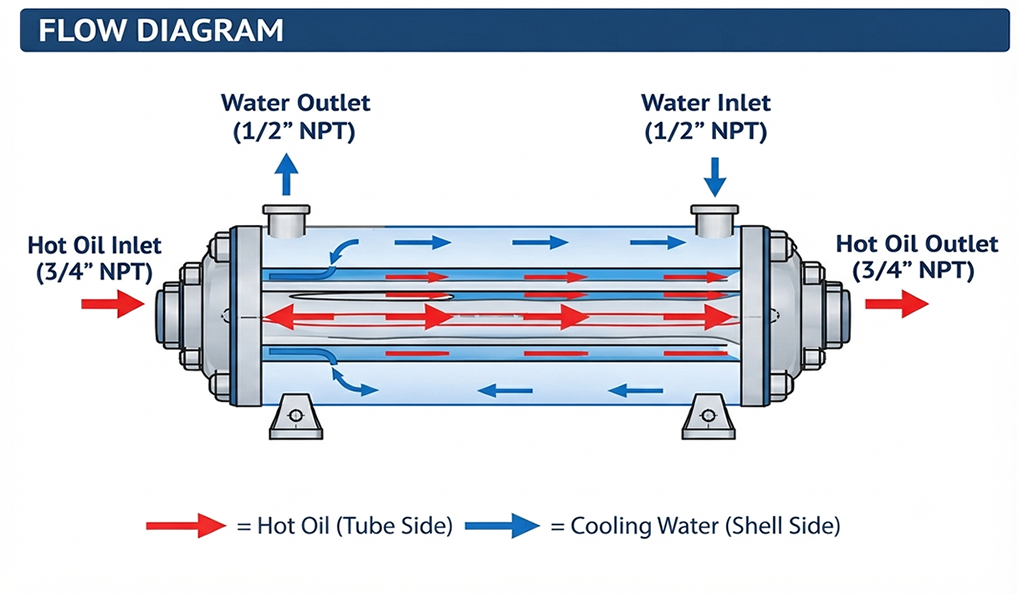
- Tube Design: Raw seawater flows through corrosion-resistant tubes (often cupro-nickel), while hot engine coolant circulates around them in a shell, absorbing heat through conduction before the cooled coolant returns to the engine.
- Countercurrent Flow: Most designs use countercurrent flow, where seawater and coolant move in opposite directions, maximising the temperature gradient along the entire length and significantly improving overall heat transfer efficiency.
- Material Selection: Components are built from corrosion-resistant materials like cupro-nickel, titanium, or coated steel because constant seawater exposure causes galvanic corrosion, scaling, and biofouling that degrade performance over time.
- System Integration: The exchanger connects to a raw water pump, thermostat, and zinc anodes, forming a closed-loop cooling circuit that protects the engine from overheating while preventing saltwater from directly damaging internal components.
Types of Marine Heat Exchangers
As a leading marine heat exchanger manufacturer, we offer all five major types listed below, each suited to different onboard applications and vessel requirements:| Type | Design | Efficiency | Maintenance | Typical Applications |
|---|---|---|---|---|
| Shell & Tube | Tube bundle inside cylindrical shell | Moderate | Easy — tubes accessible for cleaning | Engine jacket water, lube oil cooling, fuel oil heating |
| Plate | Corrugated metal plates in a frame | High | Moderate — plates must be disassembled | HVAC, jacket water, freshwater generators |
| Keel Cooler | Tubes mounted externally on hull | Moderate | Low — no internal seawater circuit | Tugs, dredgers, workboats |
| Box Cooler | Tube bundle inside hull sea chest | Moderate–High | Low — protected within hull | Offshore vessels, ferries, naval craft |
| Air-Cooled | Finned tubes with fan-forced air | Low–Moderate | Low — no seawater contact | Generators, ancillary machinery rooms |
Shell and Tube Heat Exchangers
The Shell and Tube Heat Exchanger design is the most commonly used and well-known type in marine applications. It includes a cylindrical shell that holds a group of small tubes. One fluid moves inside the tubes, while another fluid flows around them within the shell. Baffles placed inside the shell guide the outer fluid in a zigzag path, which increases contact time and enhances heat transfer.
Shell and tube heat exchangers are preferred because of their strong construction, simple maintenance, and ability to work under high pressure and large flow conditions. They are widely used in main engine freshwater cooling systems, lube oil cooler, and fuel oil heating systems on large ships.
Plate Heat Exchangers
Plate Heat Exchanger consist of a series of thin, corrugated metal plates clamped together in a frame. Each alternating gap between plates carries one of the two fluids. The corrugated pattern of the plates creates turbulence in the fluid flow, dramatically increasing heat transfer coefficients compared to smooth surfaces.
These units are compact, lightweight, and highly efficient—making them increasingly popular on modern vessels where space is at a premium. Their main drawback is susceptibility to fouling and scaling, which can reduce efficiency over time if maintenance is not performed regularly. They are commonly used in HVAC systems, jacket water cooling, and freshwater generators aboard vessels.
Keel Coolers
A keel cooler is an external heat exchanger mounted on the outside of the vessel's hull, typically along the keel. Hot engine coolant circulates through a series of tubes or rectangular sections welded to the hull plate, where the surrounding seawater absorbs the heat directly.
Because keel coolers use the open sea as a heat sink, they eliminate the need for a raw water pump and avoid the problems of seawater entering the vessel. They are extremely reliable, have no moving parts, and are particularly well-suited to shallow-water vessels such as dredgers, tugs, and workboats where seawater intake screens could become blocked by debris.
Box Coolers
Box coolers are a variation of the keel cooler concept, where a bundle of tubes is fitted inside a sea chest—a box-shaped cavity cut into the hull and open to seawater. Coolant circulates through the tube bundle while seawater floods the chest and carries away the heat. Box coolers combine the reliability of external cooling with better protection from physical damage since the tubes are contained within the hull rather than exposed externally.
Air-Cooled Heat Exchangers
While less common in marine propulsion, air-cooled heat exchanger are used in certain applications such as generator cooling and ancillary machinery rooms where the equipment is well ventilated. Hot fluid passes through finned tubes, and fans force ambient air across the fins to carry heat away. Their simplicity and freedom from seawater corrosion make them attractive in enclosed spaces, though their lower thermal capacity limits them to smaller heat loads.
Marine Heat Exchanger Technical Specifications
| Parameter | Specification |
|---|---|
| Shell Material | Carbon Steel, SS316L, Naval Brass, Aluminum Bronze |
| Tube Material | Titanium, Cupro Nickel 90/10, Cupro Nickel 70/30, SS316L |
| Operating Pressure | Up to 25 bar |
| Operating Temperature | -10°C to 300°C |
| Shell Diameter | 100 mm to 1500 mm |
| Design Standards | ASME Section VIII, TEMA, DNV, BV, LR |
| Corrosion Protection | Sacrificial Zinc Anodes, Anti-fouling Coatings |
| Vessel Types | Cargo Ships, Naval Vessels, Tugs, Offshore Platforms, Fishing Trawlers |
| Lead Time | 4 to 10 weeks |
| Manufacturing Location | Coimbatore, Tamil Nadu, India |
Materials Used in Marine Heat Exchangers
Material selection is perhaps the single most important engineering decision a marine heat exchanger manufacturer makes. Seawater is intensely corrosive, containing dissolved salts, dissolved oxygen, microorganisms, and suspended solids that attack most metals aggressively.
Copper-Nickel Alloys (90/10 and 70/30)
Copper-nickel alloys have been the material of choice for decades. They offer excellent corrosion resistance in seawater, good thermal conductivity, and natural antifouling properties. The 90/10 copper-nickel alloy (90% copper, 10% nickel) is used in the majority of shell and tube marine exchangers and provides an outstanding balance of cost and performance.
Titanium
has become increasingly popular for demanding applications. It offers exceptional corrosion resistance even in highly aggressive or polluted waters, is lighter than copper alloys, and maintains its properties at elevated temperatures. While significantly more expensive, titanium is the material of choice for naval vessels, offshore installations, and applications where long service life without maintenance is paramount.Stainless steel
(particularly grade 316L) is used in many freshwater and moderate seawater applications. It offers good corrosion resistance and mechanical strength, though it can suffer from crevice corrosion and pitting in stagnant seawater conditions.Aluminum bronze
is frequently used for shell bodies and end covers, offering good strength and moderate seawater corrosion resistance at a lower cost than other copper alloys.Marine Heat Exchanger Applications on Ships and Vessels
Marine heat exchangers serve a wide range of functions across different vessel systems:
Main Engine Jacket Water Cooling
The primary application aboard ships. A closed freshwater circuit absorbs combustion heat from the engine block and transfers it to seawater through the heat exchanger.
Lube Oil Cooling
Keeps engine and gearbox oil at optimal viscosity. Heat exchangers in the lube oil circuit prevent oil degradation and protect critical rotating components from thermal damage.
Charge Air Cooling (Intercooling)
Used on turbocharged engines to cool compressed air before it enters the cylinders, increasing air density, improving combustion efficiency, and boosting power output.
Fuel Oil Heating
Heavy fuel oil (HFO) must be heated to reduce viscosity before injection. Steam or hot water heat exchangers bring the fuel to the correct temperature for efficient combustion.
Hydraulic Oil Cooling
Prevents overheating in hydraulic systems for steering gear, deck machinery, and thrusters, maintaining reliable operation and protecting seals and pumps.
HVAC and Refrigeration
Heat exchangers transfer heat between air conditioning circuits and seawater or chilled water loops, ensuring comfortable crew and passenger conditions throughout long voyages.
Marine Heat Exchanger Maintenance and Inspection Guide
Proper maintenance of marine heat exchangers is critical to vessel reliability and preventing costly breakdowns at sea.
Regular Cleaning
Clean seawater-side surfaces at every scheduled drydocking. Mechanical brushes and high-pressure water jets remove biological fouling. Chemical descaling dissolves mineral scale without damaging the metal.
Pressure Testing
Pressure test after every reassembly to confirm tube bundle and gasket integrity. Any tube showing pitting, cracking, or thinning should be plugged or replaced immediately to prevent cross-contamination between circuits.
Flow Rate Monitoring
Monitor flow rate during operation to detect marine heat exchanger performance degradation early. A rising temperature differential or increased pressure drop signals fouling or blockage before it becomes serious.
Gasket and O-Ring Replacement
Replace gaskets and O-rings every time the unit is opened for cleaning. Elastomeric seals degrade due to heat cycling and chemical exposure — fresh seals are an inexpensive insurance policy against leaks and fluid cross-contamination aboard vessels.
United Cooling Systems — Marine Heat Exchanger Manufacturer in India
At United Cooling Systems, we are a trusted Marine Heat Exchanger Manufacturer in India based in Coimbatore, Tamil Nadu. With decades of manufacturing experience, we supply custom-built marine heat exchangers to shipyards, vessel operators, and offshore companies across India and internationally.
- Custom Design: Every marine heat exchanger is engineered to your vessel's specific pressure, flow rate, and temperature requirements.
- Premium Materials: We use titanium, cupro-nickel, stainless steel 316L, and naval brass for maximum corrosion resistance in seawater environments.
- All Types Available: Shell & tube, plate, keel cooler, box cooler, and air-cooled configurations.
- Fast Delivery: Pan-India delivery with export capability to international marine markets.
- Quality Assured: Rigorous pressure testing and quality inspection before every shipment.
Contact us today for a custom quote on marine heat exchangers for your vessel or shipyard project.
Request a Marine Heat Exchanger Quote
Marine Heat Exchanger Frequently Asked Questions
1. What is a marine heat exchanger?
A marine heat exchanger is a device fitted onboard ships and vessels to transfer heat between two fluids—typically engine coolant and seawater—without letting them physically mix. It's essential for keeping main engines, lube oil systems, and onboard HVAC running safely under continuous duty at sea.2. What types of marine heat exchangers are available?
The main types are shell and tube, plate, keel cooler, box cooler, and air-cooled configurations. Each suits different vessel types and applications—shell and tube units are common for engine jacket water and lube oil cooling, while keel and box coolers are favored on tugs and workboats where a raw water pump isn't practical.3. What materials are used to build marine heat exchangers?
Because seawater is highly corrosive, marine heat exchangers are typically constructed from titanium, cupro-nickel alloys (90/10 and 70/30), stainless steel 316L, or naval brass. Material choice depends on the vessel's operating environment and how aggressive the water conditions are expected to be.4. Who manufactures marine heat exchangers in India?
United Cooling Systems Pvt. Ltd., based in Coimbatore, Tamil Nadu, manufactures custom marine heat exchangers for engine cooling, lube oil systems, and a range of other vessel applications, supplying shipyards and vessel operators across India and internationally.5. How often should a marine heat exchanger be maintained?
Most vessels service their heat exchangers at scheduled drydocking intervals, which typically includes cleaning seawater-side surfaces, pressure testing the tube bundle, replacing sacrificial zinc anodes, and swapping out gaskets. Flow rate should also be monitored between services to catch fouling or blockage early.6. How long does a marine heat exchanger typically last?
With proper material selection and regular maintenance, marine heat exchangers commonly operate reliably for 15 to 25 years, though their lifespan varies based on tube material, seawater conditions, and how consistently the vessel follows its maintenance schedule.7. Can a marine heat exchanger be repaired if a tube fails?
Yes—in shell and tube designs, a single damaged or leaking tube can usually be plugged to isolate it from the circuit, allowing the unit to stay in service until a full tube bundle replacement is scheduled. This is one reason shell and tube remains a preferred design for critical marine applications.Choosing the Right Marine Heat Exchanger Manufacturer
Marine heat exchangers are indispensable workhorses of the maritime world. From keeping main engines cool on ocean crossings to enabling comfortable HVAC conditions for crew and passengers, they perform their function silently and continuously in some of the harshest conditions on earth. Selecting the right type for the application, using appropriate corrosion-resistant materials, and maintaining these systems rigorously are the foundations of reliable vessel operation. As the maritime industry pushes toward greater efficiency and sustainability, heat exchanger technology will continue to evolve — but its fundamental role in keeping vessels safe and operational will never change. Partnering with an experienced marine heat exchanger manufacturer like United Cooling Systems ensures your vessel gets equipment engineered to last.


