


What a Copper Heat Exchanger Actually Does:
A copper heat exchanger is designed to move thermal energy from one fluid to another without allowing the two fluids to physically mix.
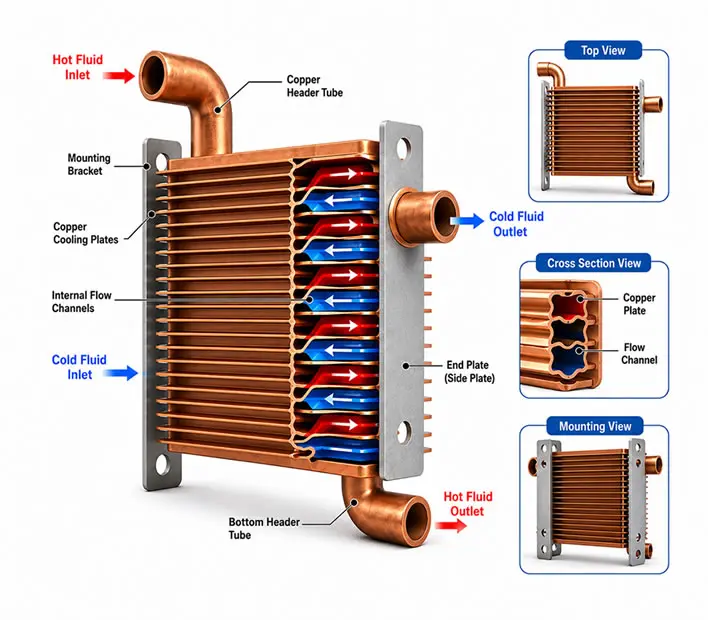
Strip away the marketing language, and a heat exchanger has one job: move thermal energy from one fluid to another without letting the two fluids physically mix. A copper heat exchanger performs this job using copper — usually in the form of tubes, coils, or thin stacked plates — as the barrier through which heat passes. The reason copper shows up so often in this role comes down to a single number: its thermal conductivity, roughly 385–400 W/m·K, depending on the alloy and purity. For comparison, Stainless Steel sits around 16 W/m·K and aluminum around 205 W/m·K. In practical terms, a copper wall lets heat cross it far faster than a steel wall of the same thickness, which means a copper unit can hit the same heat transfer target with a smaller surface area, a smaller footprint, and often a lower total material cost per unit of output.
That's the physics. What people searching this term actually want to know is whether that translates into a better product for their specific situation—and that depends heavily on what's flowing through the tubes.
Why Copper Wins in Some Jobs and Loses in Others
No material is universally correct, and treating copper as a default choice is how people end up with premature failures. Here's an honest breakdown.
Where copper is the clear winner:
- Clean water and glycol systems. Domestic hot water, hydronic heating loops, solar thermal circuits, and closed-loop chilled water systems are copper's home turf. Low chloride content, near-neutral pH, and no abrasive particulates mean copper can run for decades without measurable wall loss.
- Refrigerant circuits. Copper's ductility makes it easy to braze into tight coil geometries, and it's compatible with the vast majority of common refrigerants, which is why it dominates air conditioning and refrigeration coil manufacturing.
- Anywhere hygiene matters. Copper ion release has a measurable bactericidal effect on surfaces it contacts. This isn't a marketing claim—it's documented in food-grade and potable-water contexts, which is part of why copper remains common in brewery and dairy heat exchange even where stainless steel dominates the rest of the process line.
Where copper struggles or needs an alloy upgrade:
- High-chloride water. Standard C12200 copper pits and corrodes in water with sustained chloride levels above roughly 200 ppm. Chloride levels are the single most common cause of premature copper exchanger failure, and it's why straight copper should never go into raw seawater service without switching to a copper-nickel alloy (C70600 or C71500), which trades a bit of thermal conductivity for dramatically better resistance to chloride attack and biofouling.
- Ammonia and acetylene service. Copper reacts with both. This rules it out for ammonia refrigeration systems and most acetylene handling—stainless steel or specialty alloys are required instead.
- High-velocity erosive flow. Fine suspended solids at high flow velocity will erode copper tube walls over time (erosion-corrosion). If your process stream carries grit, sand, or scale particulates, either slow the design velocity down or reconsider the material.
Copper vs. Other Materials at a Glance
| Property | Copper (C12200) | Copper-Nickel (C70600) | Stainless Steel 316 | Aluminum |
|---|---|---|---|---|
| Thermal conductivity | ~385 W/m·K | ~45 W/m·K | ~16 W/m·K | ~205 W/m·K |
| Chloride/seawater resistance | Poor | Excellent | Good | Poor |
| Ammonia compatibility | Not compatible | Not compatible | Compatible | Compatible |
| Antimicrobial surface | Yes | Yes | No | No |
| Typical service life (clean water) | 20–30 years | 25–35 years | 25+ years | 10–15 years |
| Relative material cost | Moderate | Higher | Higher | Lower |
| Ease of brazing/repair | Easy | Moderate | Difficult (welding only) | Moderate |
This table is the fastest way to sanity-check a material decision before requesting a quote—if your fluid has any chloride content above trace levels, move straight to the copper-nickel column rather than starting with standard copper.
The Configurations Buyers Actually Compare
Once someone has decided copper is the right base material, the next search is almost always around configuration—because "copper heat exchanger" as a category covers several very different physical designs.
Many copper tubes are bundled inside an exterior shell in Shell and Tube devices. One fluid runs through the tube bundle; the other circulates around it in the shell space. This is the workhorse design for industrial process cooling because it scales from lab-bench sizes up to multi-megawatt duties, tolerates a wide range of pressures, and can be mechanically cleaned by pulling the tube bundle for inspection.
Brazed Plate Heat Exchanger stack thin, corrugated copper plates and vacuum-braze them into a sealed block. The corrugation pattern creates turbulent flow across a very high surface-area-to-volume ratio, which is why a plate unit the size of a briefcase can do the thermal work of a shell-and-tube unit several times its size. The tradeoff is that brazed plate units generally can't be mechanically cleaned or repaired internally—if fouling or a leak develops, the unit is typically replaced rather than serviced.
Coil-in-shell and fin-and-tube coils are the design behind most air-to-liquid heat transfer — think air handler coils, dry coolers, and radiators. Copper tubing is mechanically expanded into fins (often aluminum, sometimes copper) to maximize air-side surface area, since air is a comparatively poor heat transfer medium and needs much more contact area than a liquid-to-liquid design would.
Double-wall (leak-detection) exchangers use two concentric tube walls with an air gap between them so that a failure in the inner wall vents to the atmosphere rather than contaminating the secondary fluid. Many plumbing and food-safety codes mandate this design specifically for potable water heated indirectly by a boiler loop or heat-transfer fluid.
| Configuration | Best for | Footprint | Serviceable? | Typical duty range |
|---|---|---|---|---|
| Shell-and-tube | Industrial process cooling, large-scale duty | Large | Yes — bundle can be pulled and cleaned | 5 kW – 5 MW |
| Brazed plate | Space-constrained HVAC, refrigeration, heat pumps | Compact | No — sealed unit | 2 kW – 1,500 kW |
| Fin-and-tube coil | Air-to-liquid (HVAC, radiators, dry coolers) | Medium | Limited — fin cleaning only | Varies by coil size |
| Double-wall | Potable water, food-grade, code-mandated leak isolation | Medium | Limited | Varies by application |
Reading a Spec Sheet: What the Numbers Actually Mean
A recurring problem in this space is that spec sheets get published without context, so buyers see numbers they can't evaluate. Here's what actually matters when comparing units:
Working pressure rating should exceed your system's maximum operating pressure by a meaningful safety margin, not just match it—accounting for pressure spikes during pump startup, valve closure (water hammer), or thermal expansion in a closed loop. Operating temperature range matters most at the extremes. From cryogenic temperatures up to around 250°C, copper functions effectively; at prolonged high heat, annealing and strength loss become issues. Fouling factor allowance is often the most misunderstood spec. A unit sized only for "clean" thermal duty will underperform within months if the actual fluid carries any scale-forming minerals or biological growth. Ask any manufacturer what fouling factor was assumed in their sizing calculation—if they can't answer, the sizing wasn't done rigorously.
The connection standard (NPT, BSP, ANSI flange, DIN/EN flange) needs to match your piping standard exactly; adapters introduce extra joints and extra leak points.
Before You Request a Quote: What to Nail Down First
Once someone is close to buying, the questions they're typing into Google change tone — less "how does this work" and more "what will make me regret this purchase." In practice, five details separate a smooth procurement from an expensive mistake.
- Know both fluids, not just one. Buyers often specify the process-side fluid carefully and treat the other side as an afterthought. Chloride concentration, pH, dissolved oxygen, glycol ratio, and any corrosion inhibitors matter on both sides of the exchanger—a compatible primary fluid paired with an aggressive secondary fluid still corrodes the unit from the inside.
- Size for real operating conditions, not nameplate maximums. A unit sized purely to hit peak design load often runs oversized and inefficient at typical part-load conditions, which is where it actually operates most of the time. Ask for performance at your normal operating flow and temperature spread, not just the worst-case number used to justify the purchase.
- Match the footprint to where the unit will actually sit. This sounds obvious until a compact plate exchanger gets specified for a mechanical room with no clearance to swap it out later, or a shell-and-tube unit gets crammed into a space with no room to pull the tube bundle for cleaning. Draw the installation envelope before selecting configuration, not after.
- Decide how much serviceability you're willing to pay for. A brazed plate unit costs less upfront and takes less space, but if fouling or a leak develops, the whole unit is typically scrapped rather than repaired. A shell-and-tube design costs more in footprint but can be opened, cleaned, and re-gasketed in the field for decades. Neither is wrong—but pick deliberately, not by default.
- Confirm certification requirements before fabrication starts, not after. ASME Section VIII, PED 2014/68/EU, and CE marking each involve different design margins, documentation, and testing procedures baked in during manufacturing. None of these can be added retroactively once a unit is built, so get your project's actual regulatory requirement in writing before placing the order.
Common Failure Modes and What They Signal
If someone is searching because an existing copper heat exchanger is underperforming or has failed, the symptom usually points to a specific cause:
- Pinhole leaks after a few years in water service almost always trace back to either high chloride content or stray electrical current causing electrolytic corrosion—check for grounding issues on the system before assuming it's a material defect.
- Declining thermal performance over time with no leak is the signature of fouling—scale buildup on the water side or oil/grease buildup on the process side. This is a maintenance and water-treatment issue, not a design flaw.
- Erosion visible at tube inlet points to flow velocity that's too high for the fluid's solids content, concentrating wear right where flow enters the tube bundle.
- Blue-green staining on nearby surfaces indicates copper is actively corroding and leaching into the water—a sign that the fluid chemistry was outside copper's compatible range from the start.
Sustainability Considerations Buyers Are Increasingly Asking About
Search intent around copper heat exchangers has shifted in recent years to include environmental and lifecycle questions, driven partly by procurement policies requiring recyclability documentation. Copper is essentially infinitely recyclable without loss of thermal or mechanical properties, and it retains meaningful scrap value at end of life—both genuinely relevant facts for anyone evaluating total lifecycle cost or sustainability reporting requirements, not just upfront price.
Frequently Asked Questions
1. How long does a copper heat exchanger actually last?
2. In clean water or glycol service with correctly matched chemistry, 20–30 years is a realistic expectation. In high-chloride or poorly treated water, failure can occur within a few years — the fluid, not the metal, usually determines the outcome.
3. Can copper heat exchangers be used with seawater?
Not in standard C12200 copper. Seawater and other high-chloride fluids require a copper-nickel alloy such as C70600 or C71500, which sacrifices some conductivity for much better resistance to chloride pitting and biofouling.
4. Is a copper heat exchanger better than stainless steel?
Neither is universally "better." Copper wins on thermal conductivity, compactness, and hygiene; stainless steel wins on chemical compatibility with ammonia and highly corrosive or high-chloride fluids. The right answer depends on fluid chemistry, not brand preference.
5. Why is my copper heat exchanger losing efficiency over time?
This is almost always fouling—mineral scale or biological buildup reducing effective heat transfer surface—rather than a defect. Regular flushing or a water-treatment program typically restores performance.
6. What certifications should I ask for when buying one?
Depending on your jurisdiction and application, look for ISO 9001:2015 (quality management), ASME Section VIII Div. 1 (pressure vessel code, common in North America), and PED 2014/68/EU with CE marking (required for pressure equipment sold in the EU).
7. How is a custom copper heat exchanger sized?
A proper sizing calculation starts with required heat duty (kW or BTU/hr) at actual flow rates and temperature differentials, then applies a fouling factor allowance based on real fluid conditions — not just clean-water assumptions — before selecting configuration and surface area.
Conclusion
Copper heat exchangers earn their reputation honestly in clean water, refrigerant, and hygiene-critical applications, but the material choice should always follow a fluid-compatibility check rather than precede it. Configuration should follow duty and maintenance access, not just footprint. Spec sheet numbers are only meaningful in the context of the fouling and pressure margins actually assumed during sizing. Getting those three decisions right — material compatibility, configuration, and sizing margin — accounts for nearly all the difference between a copper heat exchanger that runs for thirty years and one that needs replacing in three.


