

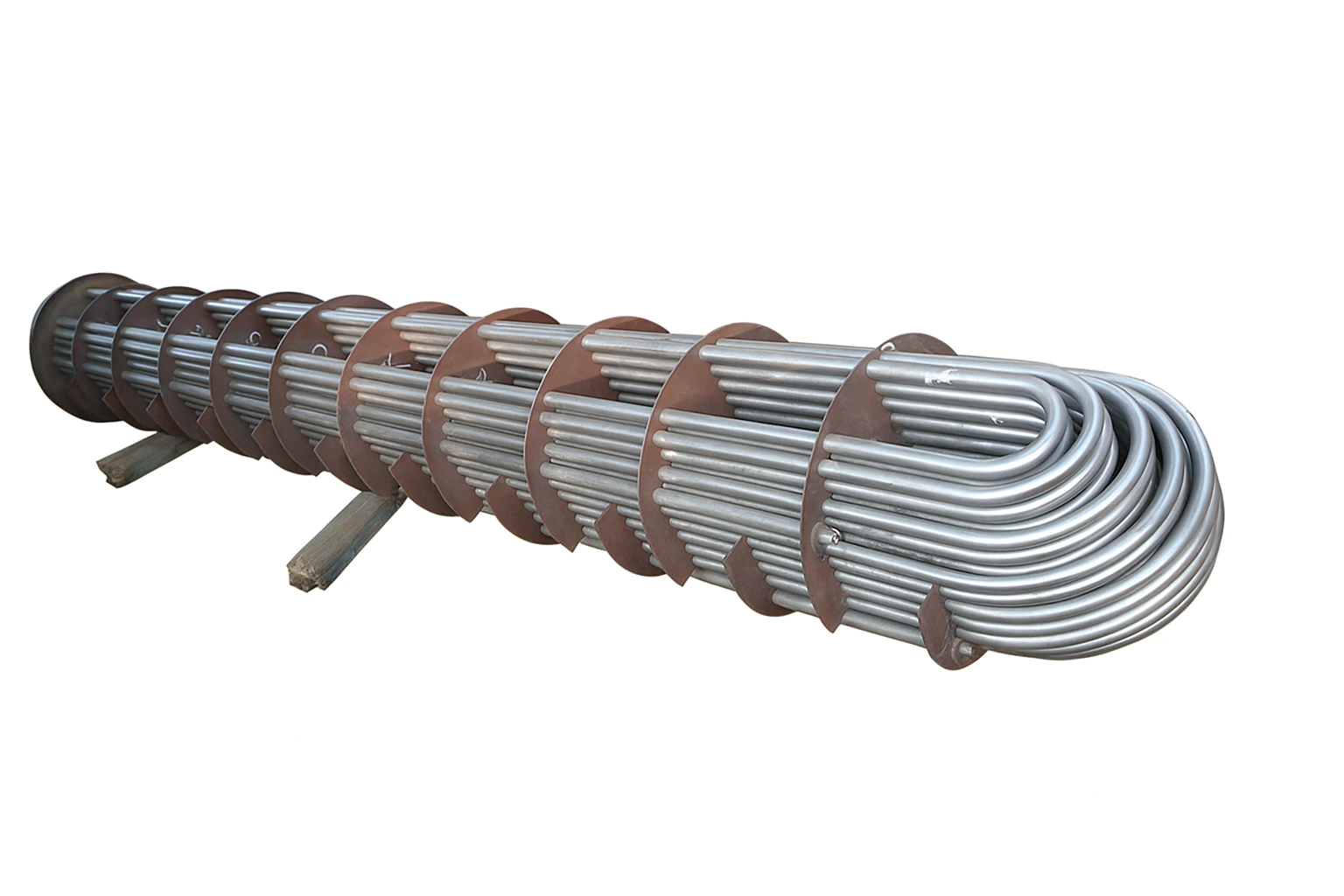
What Is a U-Tube Heat Exchanger?
A U-tube heat exchanger is a shell and tube heat exchanger in which the tubes are bent into a U shape, allowing one fluid to flow through the tubes while a second fluid flows around them inside the shell, transferring heat through the tube walls without the two fluids ever mixing.
The defining feature is the U-bend itself: because both ends of each tube terminate at the same tubesheet, the free end of the bend can expand and contract with temperature changes without placing stress on the tube-to-tubesheet joints. This makes the design especially reliable in applications with large or frequent temperature swings.
Key Characteristics
- U-shaped tube bundle: Multiple small tubes bent into a U, bundled together inside a single outer shell.
- Single tubesheet: Both ends of every tube connect to one tubesheet, simplifying construction compared to designs with two.
- Two separate flow paths: One fluid flows inside the tubes; a second fluid flows around the outside of the tubes within the shell.
- Indirect heat transfer: Heat moves through the tube walls from one fluid to the other — the fluids themselves never come into contact.
- Free thermal expansion: The U-bend absorbs expansion and contraction without mechanical stress, unlike straight-tube designs that may require expansion joints.
U-Tube Heat Exchanger Technical Specifications
| Parameter | Specification |
|---|---|
| Shell Diameter | 150 mm – 2500 mm |
| Design Pressure | Up to 100 kg/cm² |
| Design Temperature | Up to 450°C |
| Tube Material | CS, SS304, SS316L, Duplex, Titanium, Copper Alloys |
| Shell Material | Carbon Steel, Stainless Steel, Alloy Steel |
| Tube Bundle | Removable U-Tube Bundle |
| Standards | ASME Section VIII Div.1, TEMA, IS 2825 |
| Testing | Hydrostatic, Radiography, PMI, DPT, MPT |
| Manufacturing Location | Coimbatore, Tamil Nadu, India |
✅ All specifications customizable. Contact our engineering team with your process datasheet for a tailored design.
How Does a U-Tube Heat Exchanger Work?
Fluid A enters the tubes
Fluid (hot or cold) goes into one end of the tube bundle.
It travels down the tube, reaches the bend, and comes back through the other side of the U.
Fluid B flows in the shell
Another fluid flows around the outside of the tubes, inside the shell.
Metal plates called baffles guide this fluid across the tubes to improve heat transfer.
Heat transfer happens
Heat moves from the hot fluid → through the tube metal → to the cold fluid.
Fluids stay separate and safe.
Key Components of a U-Tube Heat Exchanger
A U-tube heat exchanger is composed of several critical components that work together to ensure efficient heat transfer:
- U-Shaped Tubes: These tubes are the core of the heat exchanger, with a unique bent design that allows the fluid to pass through the "U" shape. The tubes are usually made of materials like stainless steel or copper to ensure durability and high thermal conductivity.
- Shell: The external casing of the heat exchanger, known as the shell, contains the U-tubes. The shell is responsible for holding the secondary fluid and directing it over the tubes. Materials such as carbon steel or stainless steel are commonly used for constructing the shell.
- Tube Sheets: These are the structural elements that hold the ends of the U-tubes in place and create a barrier between the two fluids, preventing them from mixing.
- Baffles: Baffles are placed inside the shell to direct the flow of the secondary fluid around the tubes, promoting turbulence, which improves heat transfer efficiency.
- Heads: At either end of the heat exchanger are the heads, which allow for the entry and exit of fluids. These heads can be removed for easy access during maintenance or cleaning.
- Manways/Nozzles: These provide access points for inspection, maintenance, and fluid inlet and outlet connections.
- Built to ASME / TEMA international standards
- Fully customizable size, material, and configuration
- In-house quality testing before dispatch
- Serving clients across India and internationally
- Two manufacturing units in Coimbatore
Operating Principle of U-Tube Heat Exchangers
The primary principle behind a U-tube heat exchanger is the transfer of heat between two fluids that are at different temperatures. Here's a step-by-step breakdown of the operation:
Fluid Entry: One fluid enters the U-tube heat exchanger through the tube sheet and flows through the U-shaped tubes.Heat Transfer: As the fluid flows through the tubes, it comes into contact with the tube walls. The heat from this fluid is transferred to the second fluid, which is circulating around the tubes in the shell.
Shell Fluid Flow: The second fluid enters the shell and flows around the U-tubes. It absorbs heat from the first fluid, which increases the temperature of the shell-side fluid while reducing the temperature of the tube-side fluid. Fluid Exit: After the heat exchange process, both fluids exit the heat exchanger at different temperatures. The tube-side fluid exits cooler, and the shell-side fluid exits warmer.The U-tube design allows for the thermal expansion of the tubes without creating stress in the system, making it highly reliable for applications involving significant temperature changes.
Advantages of U-Tube Heat Exchangers in Industrial Applications
U-tube heat exchangers offer numerous benefits that make them highly suitable for a wide range of industrial applications:
Accommodation of Thermal Expansion: The U-shaped tubes allow the heat exchanger to handle temperature-induced expansion and contraction without putting stress on the tubes, reducing the risk of damage over time. Space-Efficient Design: U-tube heat exchangers are compact, making them ideal for installations with limited space. Improved Durability: Due to their robust construction and ability to withstand high temperatures and pressures, U-tube heat exchangers are highly durable and suitable for demanding industrial environments. Ease of Maintenance: The removable tube bundle simplifies the process of cleaning, inspection, and replacement, reducing downtime and maintenance costs. Enhanced Heat Transfer Efficiency: The arrangement of the U-tubes and the use of baffles in the shell promotes fluid turbulence, increasing the efficiency of heat transfer between the two fluids. Cost-Effectiveness: U-tube heat exchangers are cost-effective in the long run due to their reliable performance, low maintenance needs, and durable design.Why Choose United Cooling Systems for U-Tube Heat Exchangers?
United Cooling Systems Pvt. Ltd. is one of the most trusted U-tube heat exchanger manufacturers in India. Based in Coimbatore, Tamil Nadu, we have supplied high-quality heat exchangers to clients across the oil & gas, power, and chemical industries for over 36years.
U-Tube Heat Exchanger Applications in Power, Oil & Gas, and Chemical Industries
U-tube heat exchangers are utilized across a wide variety of industries where efficient heat transfer is essential. Some of the most common applications include:
Power Plants: In both thermal and nuclear power stations, U-tube heat exchangers are used for heat recovery and maintaining appropriate temperatures in fluid systems. Oil and Gas Industry: U-tube heat exchangers are critical in refining, drilling, and chemical processing operations, where they are used to control temperatures and recover heat from various processes. Chemical and Petrochemical Processing: In the chemical industry, U-tube heat exchangers are employed in distillation columns, reactors, and heat recovery systems to optimize energy usage and control process temperatures. HVAC Systems: U-tube heat exchangers play a crucial role in heating, ventilation, and air conditioning (HVAC) systems, ensuring that fluids maintain the required temperature in large buildings, industrial complexes, or machinery cooling systems. Food and Beverage Processing: In pasteurization processes, U-tube heat exchangers are used to transfer heat from hot water or steam to the product without direct contact, ensuring the preservation of food quality. Pharmaceutical Manufacturing: In pharmaceutical production, U-tube heat exchangers help maintain precise temperatures for sensitive processes like drug formulation and vaccine manufacturing.Types of U-Tube Heat Exchangers
U-tube heat exchangers come in different variations, each tailored to specific needs and applications:
Single-Pass U-Tube Heat Exchanger: In this design, the fluid flows through the U-tubes in one pass, making it suitable for applications with moderate temperature differences. Multi-Pass U-Tube Heat Exchanger: This version has multiple passes for the tube-side fluid, improving heat transfer by increasing the flow path. It is ideal for applications requiring more efficient heat exchange. Double U-Tube Heat Exchanger: This design combines two U-tube heat exchangers to enhance heat transfer efficiency, particularly in situations where higher heat loads are involved.Important Considerations When Selecting a U-Tube Heat Exchanger
Choosing the right U-tube heat exchanger requires careful consideration of several factors to ensure optimal performance and reliability:
Fluid Compatibility: The materials of the heat exchanger must be compatible with the fluids to prevent corrosion or degradation over time. Temperature and Pressure Conditions: Ensure the heat exchanger can withstand the operating temperatures and pressures of the fluids without compromising its structural integrity. Flow Rate Requirements: The heat exchanger should be able to accommodate the required flow rates of both fluids without excessive pressure drops or inefficient heat transfer. Ease of Maintenance: Consider whether the design allows for easy access to the tubes for cleaning and inspection to minimize downtime during maintenance. Space Limitations: U-tube heat exchangers come in various sizes. Ensure the selected unit fits within the available space while meeting heat transfer requirements.U-Tube Heat Exchanger Manufacturer in India — Request a Free Quote
Looking for a reliable U-tube heat exchanger manufacturer in India? United Cooling Systems Pvt. Ltd., based in Coimbatore, Tamil Nadu, delivers custom-engineered U-tube heat exchangers for power plants, oil & gas refineries, and chemical processing industries. Contact us today for technical specifications, pricing, and a free quote.
Request a Free QuoteFrequently Asked Questions (FAQ)
1. What exactly is a U-tube heat exchanger?
A U-tube heat exchanger is a shell and tube design where the tube bundle is bent into a U, with both tube ends fixed to a single tubesheet. Hot fluid travels through the inside of the tubes while a second fluid flows around the outside within the shell, allowing heat to pass between them through the tube wall while keeping the two fluids completely separate.
2. What is the origin of the word U-tube?
The name comes directly from the shape of the tube bundle — each tube is bent 180 degrees, resembling the letter U. Fluid travels in through one leg, curves through the bend, and exits out the other leg, with both ends anchored at the same tubesheet.
3. In which industries are U-tube heat exchangers most common?
You'll find U-tube heat exchangers throughout power generation, oil and gas refining, and petrochemical processing, along with broader chemical manufacturing. These industries share a common trait: process fluids that cycle between high and low temperatures, which the U-bend design handles without added stress on the equipment.
4. What advantages does the U-tube configuration offer?
Because only one end of each tube is fixed, the U-bend can expand and contract freely as temperatures shift, eliminating the need for separate expansion joints. Combined with a single-tubesheet build, this results in a design that's simpler to manufacture, more resistant to thermal stress, and well suited to high-pressure service.
5. What's the trade-off with using a U-tube design?
The curved section of each tube is difficult to reach with mechanical cleaning tools, so scale or fouling buildup inside the bend is harder to remove than in a straight-tube exchanger. As a result, this design performs best when the fluid running through the tubes is relatively clean.
6. Is there any risk of the two fluids blending together?
No — the tube wall and tubesheet form a sealed boundary that keeps the two fluids apart for the entire operating cycle. Heat crosses this boundary freely, but the fluids themselves never physically meet.
7. How is it decided which fluid runs through the tubes versus the shell?
Engineers generally route the cleaner fluid through the tubes, since the U-bend limits access for internal maintenance, and send the fouling-prone fluid through the shell side instead. This way, the fluid most likely to need cleaning ends up in the part of the exchanger that's easiest to service.


