


What Is an Air Receiver?
An air receiver is a Pressure Vessels that stores compressed air generated by an air compressor. It does not generate or compress air itself—it simply holds it under pressure until downstream equipment draws it out. This storage function is what makes an air receiver so important: it acts as a buffer between fluctuating demand and the compressor's steady output, keeping the entire system stable.
Every industrial compressed air system, regardless of size, benefits from an air receiver. Whether it's a small workshop running a single compressor or a large manufacturing plant with continuous, high-volume air demand, the air receiver is what keeps pressure consistent and equipment protected from unnecessary wear.
Key Functions of an Air Receiver
An air receiver performs several critical roles inside a compressed air system, all of which directly affect efficiency, reliability, and operating cost.
- Pressure Stabilization — An air receiver balances pressure fluctuations, ensuring airflow stays consistent even during sudden or high-demand periods.
- Energy Efficiency —By storing compressed air during periods of low demand, the air receiver reduces how often the compressor needs to run, cutting electricity consumption and lowering operating costs.
- Moisture Separation — An air receiver acts as a first-stage moisture trap, helping separate condensed water from the compressed air before it reaches downstream equipment, reducing corrosion risk.
- Reduced Compressor Load — The air receiver buffers sudden surges in air demand, preventing the compressor from overworking. This means fewer start-stop cycles, less mechanical wear, and a longer compressor service life.
Compressor vs. Air Receiver: What's the Difference?
One of the most common questions from anyone specifying a compressed air system for the first time is how a compressor differs from an air receiver. They work together, but they perform two entirely different jobs.
| Feature | Air Compressor | Air Receiver |
|---|---|---|
| Function | Generates and pressurizes air | Stores compressed air for use |
| Power Use | Runs on electricity continuously | No power; passive storage |
| Role | Source of compressed air | Buffer that stabilizes supply |
| Moving Parts | Motor, pistons, or rotary screw | None |
| Typical Lifespan | 10–15 years | 20–25+ years |
In short: the compressor makes the air, and the air receiver stores and stabilizes it. Neither works efficiently without the other. A missing or undersized air receiver forces the compressor into constant short-cycling, wasting energy and accelerating wear.Instead, the compressor can operate in longer, significantly more efficient cycles when the air receiver is appropriately matched.
Working Principle of an Air Receiver
The operating principle behind an air receiver is straightforward but essential to understand when specifying a system:
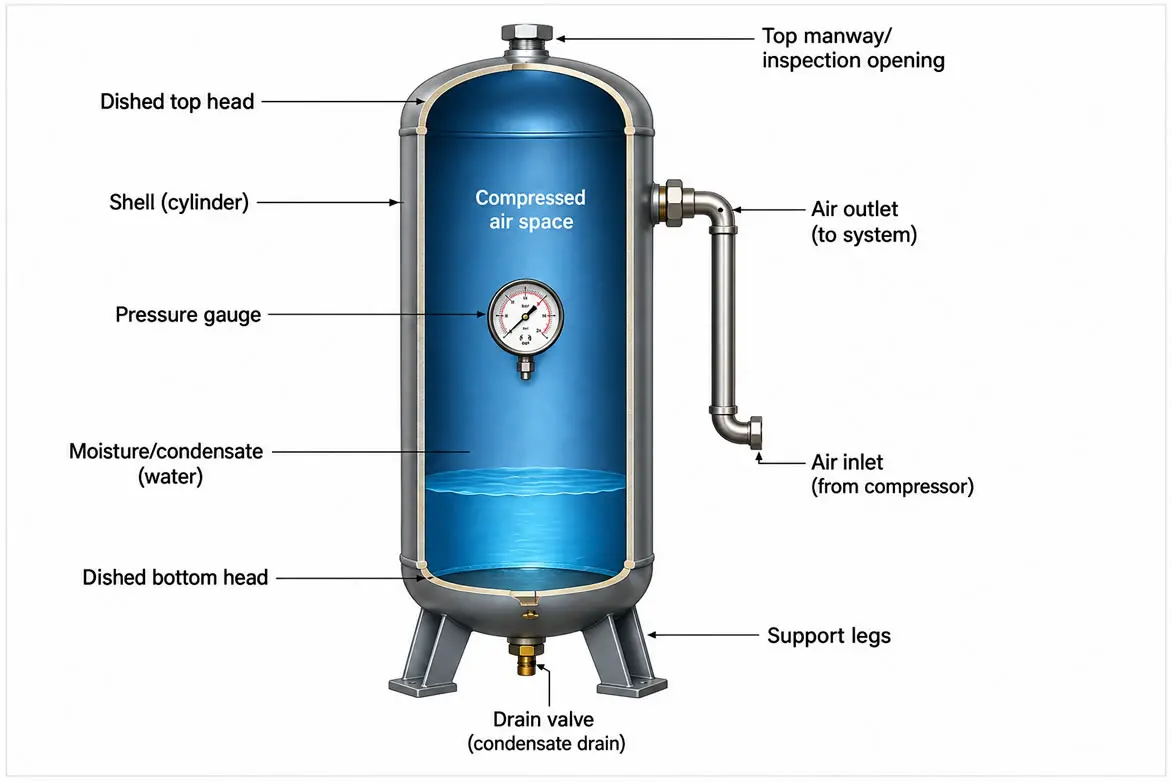
- Compressed Air Entry — Compressed air enters the air receiver directly from the compressor's discharge line as it is generated.
- Pressurized Storage — The air is held under pressure inside the sealed vessel, ready to be drawn on demand.
- Demand Draw-Down — As downstream equipment draws air for use, pressure inside the air receiver drops slightly.
- Compressor Response — Once pressure falls below a set threshold, the compressor cycles back on to replenish the supply—but far less frequently than it would without the air receiver's buffering effect.
- Stabilized Delivery — The cycle repeats continuously, smoothing out pressure delivery to downstream tools and machinery while reducing mechanical stress on the compressor.
This process lowers overall energy consumption across the system and prevents the frequent, inefficient cycling that shortens compressor lifespan and increases maintenance expenses.
Types and Configurations of Air Receivers
Air receivers are typically available in two primary configurations, each suited to different site layouts and space constraints.

- Vertical Air Receivers — Standing upright, these are the most common configuration for facilities with limited floor space. Their smaller footprint makes them ideal for workshops and compact industrial units.
- Horizontal Air Receivers — Laid flat, these are often preferred in large industrial installations where floor space is available and easier access to fittings and drain points is required.
Beyond orientation, air receivers can also be customized with features such as multiple inlet and outlet connections, automatic drain valves, insulation for outdoor installations, and additional inspection ports depending on the specific requirements of the facility.
Choosing the Right Air Receiver Size
Correctly sizing an air receiver is one of the most important decisions in specifying a compressed air system. An undersized air receiver causes excessive compressor cycling, while an oversized one adds unnecessary cost and takes up valuable floor space without providing proportional benefit.
Factors That Determine Air Receiver Size
- Compressor Flow Rate —The air receiver must be large enough to buffer the compressor's rated output, typically measured in cubic feet per minute (CFM) or cubic meters per minute, during periods of peak demand.
- Air Demand Pattern — Systems with frequent, sudden spikes in air consumption require larger air receivers to absorb those surges without overloading the compressor.
- Usage Consistency — Continuous, steady-demand operations can often run efficiently with a smaller air receiver than intermittent, high-surge operations that need extra buffering capacity.
Typical Air Receiver Sizes by Application
- Small-Scale (100–200 Liters) —Suited to workshops and light-duty applications with minimal, intermittent air demand.
- Medium-Sized (500–1000 Liters ) — Common in auto repair shops and small manufacturing operations with moderate compressed-air needs.
- Large Industrial (2000–5000 Liters) — Essential for manufacturing plants, chemical processing units, and food production facilities with high or continuous air consumption.
- Heavy-Duty (5000+ Liters) — Designed for large-scale industrial applications where air demand is constant and substantial, providing enough buffer to maintain stable pressure at all times.
Applications of Air Receivers Across Industries
Air receivers are used wherever compressed air plays a role in operations, which makes them essential equipment across a wide range of industries:
- Manufacturing Plants — Supporting pneumatic tools, automated machinery, and assembly line equipment that rely on consistent air pressure.
- Automotive Workshops — Powering air tools, tire inflation systems, and paint-spraying equipment with stable, reliable pressure.
- Chemical Processing — Providing steady compressed air for instrumentation, valve actuation, and process control systems.
- Food and Beverage Production — Supplying clean, stable compressed air for packaging lines and processing equipment.
- Construction and Fabrication — Pneumatic tools on construction sites require a steady, dependable air supply.
Benefits of a Properly Sized Air Receiver
Investing in a correctly specified air receiver pays off across multiple areas of operation:
- Lower Energy Bills — Fewer compressor start-stop cycles directly translate into reduced electricity consumption over time.
- Reliable Air Supply — Even during unexpected demand increases, a well-sized air receiver guarantees compressed air is always accessible, maintaining smooth operations.
- Extended Equipment Lifespan — Reduced compressor cycling means less mechanical wear on motors, valves, and bearings, extending the service life of the entire system.
- Better Moisture Control — The Air Receiver's moisture-separation function helps prevent corrosion and water-related damage to downstream tools and equipment.
Materials and Safety Features
Industrial air receivers rely on the right construction material and a core set of safety features to operate reliably for decades:
- Carbon Steel Construction — The most common material choice, offering reliable strength and cost-effectiveness for standard industrial pressure conditions.
- Stainless Steel Construction — Selected for corrosive environments or where product purity matters, such as food and pharmaceutical processing applications.
- Pressure Relief Valves — Prevent over-pressurization by automatically venting excess pressure before it reaches unsafe levels.
- Drain Valves — Allow regular removal of accumulated moisture, protecting the tank from internal corrosion over time.
- Pressure Gauge — Provides continuous, at-a-glance monitoring of system pressure so operators can catch abnormalities early.
These features are not optional extras — they are essential for safe, code-compliant operation of any pressure vessel.
Maintenance Best Practices for Air Receivers
Routine maintenance is what keeps an air receiver performing at its rated capacity for its full service life. Recommended practices include:
- Inspecting pressure relief valves every 6 to 12 months to confirm they function correctly.
- Draining accumulated moisture regularly to prevent internal corrosion and extend tank life.
- Checking fittings, valves, and welds periodically for signs of leaks or wear.
- Scheduling periodic internal inspection for air receivers in continuous heavy-duty service, particularly in industrial environments with high utilization rates.
Neglecting routine maintenance is one of the most common causes of premature air receiver failure and can also compromise the safety of the entire compressed air system.
Common Air Receiver Problems and How to Avoid Them
Even a well-built air receiver can develop issues over time if it isn't matched correctly to the system or maintained properly. Understanding these common problems helps facility managers catch issues early, before they lead to downtime or safety risks.
- Excessive Compressor Cycling — If the compressor is switching on and off far more frequently than expected, the air receiver is likely undersized for the system's demand pattern. Upsizing the air receiver, rather than replacing the compressor, is often the more cost-effective fix.
- Moisture Buildup and Corrosion — Failing to drain the air receiver regularly allows condensed moisture to accumulate at the bottom of the tank, accelerating internal corrosion. Automatic drain valves largely eliminate this risk when properly maintained.
- Pressure Drop Across the System — A sudden or persistent pressure drop can indicate a leak somewhere between the air receiver and downstream equipment or a relief valve that is venting prematurely due to incorrect calibration.
- Reduced Storage Capacity Over Time — Internal corrosion or sediment buildup can gradually reduce the effective working volume of an air receiver. Scheduled internal inspections catch this before it affects system performance.
Addressing these issues early, through routine inspection and correct initial sizing, significantly extends the working life of an air receiver and protects the compressor investment around it.
Air Receiver vs. Other Compressed Air Accessories
An air receiver is often installed alongside other compressed air system accessories, and it's worth understanding how it differs from them:
- Air Receiver vs. Air Dryer— An air receiver stores and stabilizes compressed air pressure; an air dryer removes moisture vapor from the air stream to prevent condensation downstream. Most systems use both together, with the dryer typically positioned after the receiver.
- Air Receiver vs. Filter/Regulator— Filters remove particulates and oil residue from the air stream, and regulators control the output pressure to downstream equipment. An air receiver doesn't filter or regulate—it simply buffers supply so the rest of the system can work more efficiently.
- Air Receiver vs. Aftercooler— An aftercooler lowers the temperature of compressed air immediately after compression, which helps condense out moisture before it reaches the receiver. The two are often paired, with the aftercooler feeding cooled, partially dried air into the receiver.
Each of these accessories plays a distinct role, and a well-designed compressed air system typically uses several of them together—the air receiver on its own solves pressure stability, not moisture or particulate control.
Air Receiver Frequently Asked Questions
1. What does an air receiver do?
An air receiver stores compressed air generated by a compressor and releases it as needed, smoothing out pressure fluctuations and reducing how often the compressor has to cycle on and off.
2. Is an air receiver truly necessary, or is it possible to operate a compressor without one?
Technically a compressor can run without one, but without an air receiver the compressor short-cycles constantly to keep up with demand, which wastes energy, causes unstable pressure, and wears out the motor and valves far faster than normal.
3. How do I know what size air receiver I need?
Sizing depends mainly on your compressor's flow rate (measured in CFM), how consistent your air demand is, and whether your system experiences sudden high-demand spikes. As a general guide, workshops typically need 100–200 liters, while large industrial plants with continuous demand often require 2000 liters or more.
4. Can an air receiver be installed outdoors?
Yes, but outdoor units typically need additional insulation or weatherproofing, along with careful attention to drain valve placement to prevent freezing in cold climates.
5. How often should an air receiver be inspected?
Pressure relief valves should be checked every 6 to 12 months, and units in continuous heavy-duty service should have a full internal inspection on a scheduled basis—local pressure vessel regulations often set a required inspection interval, so it's worth checking what applies in your region.
6. What's the difference between a vertical and horizontal air receiver?
Vertical receivers stand upright and take up less floor space, making them the common choice for workshops and compact installations. Horizontal receivers lie flat and are often preferred in larger facilities where floor space isn't a constraint and easier access to fittings and drains is a priority.


