


What Is an Evaporative Condenser?
An evaporative condenser is a heat-rejection device used in refrigeration and HVAC systems, combining air and water cooling in one unit—unlike an air-cooled condenser (air only) or a water-cooled condenser (needs a separate cooling tower). Fans push air across a refrigerant-filled coil while water is sprayed over its surface. As the water evaporates, it pulls heat away far more effectively than air alone, letting the refrigerant condense at a lower pressure. This hybrid design gives evaporative condensers lower condensing temperatures than similarly sized air-cooled units—cutting compressor energy use.
How Evaporative Condensers Work: Step by Step
- Refrigerant enters the coil—Hot high-pressure refrigerant gas from the compressor enters the finned or bare-tube coil bundle inside the unit.
- Water is recirculated over the coil—A pump draws water from the sump at the base of the unit and sprays it continuously over the coil surface through distribution nozzles.
- Air is drawn across the wetted coil—axial or centrifugal fans pull ambient air upward through the wetted coil, causing a thin film of water to evaporate.
- Evaporation removes heat—evaporating water absorbs latent heat from the refrigerant inside the coil, condensing it back into a high-pressure liquid.
- Water is recirculated, and drift is eliminated—remaining water falls back to the sump and is reused, while drift eliminators prevent water droplets from escaping with the exhaust air stream.
- Makeup water replaces losses—A float valve or level controller adds fresh water to compensate for evaporation, drift, and periodic bleed-off used to control mineral concentration.
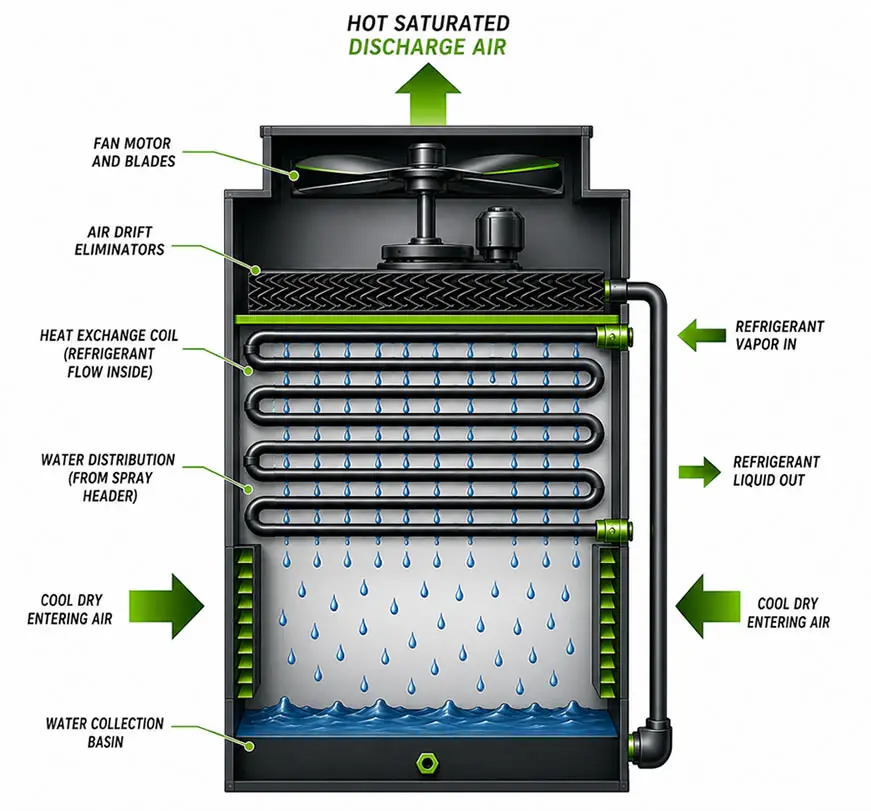
Because evaporation is a far more efficient way to remove heat than convection alone, this design allows evaporative condensers to operate at a lower condensing temperature—often 8–12°C below what a comparable air-cooled unit would achieve under the same ambient conditions.
Key Advantages Over Air-Cooled and Water-Cooled Systems
- Lower energy consumption. Because the condensing temperature stays lower, the compressor doesn't have to work as intensely to maintain the pressure differential. In practice, this design can reduce compressor power draw by 20–30% compared to an equivalent air-cooled condenser, particularly in high-ambient-temperature regions.
- Smaller footprint. A single evaporative condenser combines the function of a condenser coil and a cooling tower. Where a water-cooled system needs a separate cooling tower, pump, and piping loop, an evaporative unit does the same job in one compact package—a significant advantage for facilities where roof or yard space is limited.
- Stable performance in high heat. India's summer ambient temperatures regularly exceed 40°C in many industrial regions. Air-cooled condensers lose capacity sharply as dry-bulb temperature rises. Evaporative condensers are governed by wet-bulb temperature instead, which is almost always significantly lower than dry-bulb temperature—meaning performance holds up better exactly when your system needs it most.
- Lower water consumption than open cooling towers. Because the condensing coil is integrated directly into the unit, there's no separate condenser-water loop losing heat to a tower—reducing overall system water usage compared to a traditional water-cooled chiller plus cooling tower setup.
- Reduced long-term operating cost. Lower energy draw plus a simpler mechanical layout (fewer major components than a tower-plus-condenser combination) generally means lower maintenance overhead and a faster return on the incremental upfront cost versus air-cooled alternatives.
Evaporative vs. Air-Cooled vs. Water-Cooled Condensers
| Parameter | Evaporative Condenser | Air-Cooled Condenser | Water-Cooled Condenser + Cooling Tower |
|---|---|---|---|
| Cooling method | Air + water evaporation over coil | Ambient air only | Water loop cooled separately by a tower |
| Governing temperature | Wet-bulb temperature | Dry-bulb temperature | Wet-bulb temperature (via tower) |
| Typical energy efficiency | Highest — lowest condensing temperature achievable | Lowest — condensing temp rises sharply with ambient heat | High, but pump + tower fan add parasitic load |
| Footprint | Compact — single integrated unit | Large coil area needed for equivalent capacity | Largest — separate tower, condenser, and piping loop required |
| Water consumption | Moderate (evaporation, drift, bleed-off) | None | Highest — full open-loop tower system |
| Performance in high ambient heat (35–45°C) | Stable — governed by lower wet-bulb temperature | Degrades significantly | Stable, similar to evaporative |
| Maintenance needs | Moderate-high — water treatment, coil cleaning, nozzles | Low — mainly coil and fan cleaning | High — tower fill, condenser tubes, and water loop all need upkeep |
| Upfront cost | Moderate | Lowest | Highest (two major components) |
| Best suited for | Cold storage, pharma, dairy, ice plants, high-tonnage refrigeration | Small systems, low ambient regions, water-scarce sites | Large chiller plants where tower space isn't a constraint |
Where Evaporative Condensers Are Used
Cold storage and food processing
Cold chains for fruits, vegetables, dairy, and processed foods depend on tight, stable temperature control. Evaporative condensers are widely used in ammonia and Freon-based refrigeration systems for cold storage warehouses because they hold condensing pressure steady even during peak summer loads.
Pharmaceutical and chemical manufacturing
Processes that require precise temperature control—reactor cooling, chilled water systems, cleanroom HVAC—benefit from the tighter, more stable condensing pressures evaporative units provide compared to air-cooled alternatives.
Ice plants and dairy processing
High-capacity ammonia refrigeration systems used in ice manufacturing and dairy chilling commonly specify evaporative condensers because of their favorable capacity-to-footprint ratio at large tonnages.
Commercial and industrial HVAC
Large chiller plants serving malls, hospitals, and industrial buildings use evaporative condensers to reduce compressor energy costs across long operating hours.
Data centers
As IT load density increases, facilities are turning to evaporative cooling to manage heat rejection more efficiently than traditional air-cooled DX systems, particularly where continuous uptime and energy cost control are priorities.
Types of Evaporative Condensers
Induced-draft units
pull air through the coil using a fan mounted at the top of the unit, exhausting air vertically. These generally offer better drift control and quieter operation but require slightly more headroom.
Forced-draft units
push air through the coil using a fan mounted at the base. These have a lower overall height, making them suitable for installations with height restrictions, though they can be more prone to air recirculation if not spaced correctly.
Single-coil vs. multi-coil configurations
Larger capacity requirements are often met by combining multiple coil sections within a shared casing and water system, allowing modular capacity scaling without duplicating the entire unit.
How to Size and Select an Evaporative Condenser
Choosing the right unit isn't just about matching tonnage. Key factors to specify include:
- Design wet-bulb temperature for your location—this determines achievable condensing temperature, not the dry-bulb ambient.
- Refrigerant type (ammonia, R404A, R134a, R507, CO₂, etc.)—coil material and configuration vary by refrigerant
- Heat rejection load (TR or kW) based on actual compressor performance data, not just nominal system tonnage
- Water quality in your area—high-mineral-content water requires appropriate bleed rates and may influence coil material selection
- Coil material—galvanized steel, hot-dip galvanized, or stainless steel, depending on the corrosivity of the local environment and refrigerant compatibility
- Noise constraints—fan type and speed selection matter if the unit is near occupied spaces
- Space and structural loading—units must be mounted on structurally rated platforms or rooftops with adequate clearance for air intake and discharge.
Undersizing leads to elevated condensing pressures and compressor strain; oversizing adds unnecessary capital cost and water consumption. A proper selection is based on actual heat rejection calculations for your refrigeration or chiller system, not generic capacity charts.
Maintenance Considerations
Evaporative condensers require more active maintenance than sealed air-cooled units, but the payoff in energy savings generally outweighs this. Core maintenance tasks include:
- Periodic cleaning of coil surfaces to prevent scale buildup, which reduces heat transfer efficiency
- Water treatment programs to control mineral scaling, corrosion, and biological growth (including Legionella risk management in the recirculating water system)
- Regular inspection and cleaning of spray nozzles and distribution systems
- Drift eliminator inspection to maintain water conservation and prevent nuisance drift
- Pump and fan motor servicing per manufacturer schedules
Facilities that budget for this ongoing maintenance typically see the unit sustain its rated efficiency over its full service life, rather than degrading and losing the energy advantage that justified the investment.
Choosing a Manufacturer
Not all evaporative condensers are built to the same standard. Before finalizing a supplier, verify:
- Coil construction material and corrosion protection method
- Fan and motor efficiency ratings, and whether variable-speed options are available for part-load energy savings
- Structural build quality—panel gauge, frame construction, and casing material
- Whether the manufacturer provides performance data specific to your design conditions, rather than generic published capacity tables
- After-sales support, spare parts availability, and site commissioning support
- Compliance with relevant standards for pressure-bearing components and refrigeration safety codes
Frequently Asked Questions
1. How much energy can an evaporative condenser actually save compared to an air-cooled unit?
Savings vary by climate and load profile, but many industrial installations see compressor energy reductions in the range of 20–30%, driven by the lower condensing temperature evaporative cooling achieves relative to dry air-cooled systems, especially in hot climates.
2. Do evaporative condensers use more water than air-cooled systems?
Yes—they consume water through evaporation, drift, and bleed-off, whereas air-cooled units use none. However, compared to a separate cooling tower plus water-cooled condenser setup, an integrated evaporative condenser is often more water-efficient overall.
3. What refrigerants are compatible with evaporative condensers?
Most common refrigerants—ammonia (NH₃), R404A, R134a, R507, R22, and CO₂—can be used with evaporative condensers, provided the coil material and configuration are matched to the refrigerant's pressure and corrosivity characteristics.
4. How often does the water in an evaporative condenser need to be treated?
Water treatment should be continuous, not periodic—typically involving ongoing chemical dosing for scale and corrosion control, along with a bleed-off rate calibrated to your local water hardness, to prevent mineral buildup on coil surfaces.
5. Can an evaporative condenser be installed on a rooftop?
Yes, rooftop installation is common, provided the structure is rated for the unit's operating weight (including water load) and there's adequate clearance for air intake and discharge to avoid recirculation of warm exhaust air.
6. What's the typical lifespan of an evaporative condenser?
With proper water treatment and maintenance, evaporative condensers commonly operate reliably for 15–20 years, though coil life depends heavily on water quality management and material selection.
7. How is an evaporative condenser different from a cooling tower?
A cooling tower cools water that is then circulated to a separate shell-and-tube or plate condenser. An evaporative condenser integrates the refrigerant coil directly into the evaporative cooling process, eliminating the separate condenser-water loop and reducing both footprint and pumping energy.
Conclusion
Evaporative condensers offer one of the most effective ways to cut compressor energy costs and improve cooling reliability in India's demanding industrial climate. By combining air and water cooling in a single compact unit, they deliver lower condensing temperatures, smaller footprints, and better performance during peak summer loads than air-cooled alternatives—while requiring less space and a simpler mechanical layout than separate water-cooled condenser and cooling tower systems.
The right choice depends on your refrigerant, load profile, local wet-bulb design conditions, and water quality—which is why proper sizing and a manufacturer who can back their units with real performance data matter more than generic capacity claims.
Request a Custom Evaporative Condenser Quote

