Heat Exchanger Certification
What Is an Air Cooled Condenser
09-11-2024

Facing severe water scarcity, rising utility costs, and tightening environmental regulations, Indian industries are rapidly shifting toward sustainable thermal management solutions. Air-cooled condensers (ACCs) have emerged as the definitive choice for facilities seeking reliable heat rejection without the heavy water dependency, chemical treatment costs, and scaling headaches inherent to water-based systems.


This comprehensive guide explores how ACCs operate, their optimal industrial applications, and critical selection criteria. An air-cooled condenser is an advanced heat exchanger that rejects heat directly to ambient air by routing hot process vapor or refrigerant through a finned-tube coil bundle, where industrial fans force airflow to convert the vapor back into a liquid. Crucially, this eliminates water consumption entirely, removing risks of biological growth like Legionella, fouling, and equipment corrosion.


While they trade a degree of thermal efficiency during peak summer temperatures for total water independence, ACCs provide unmatched operational simplicity, minimal maintenance, and strict regulatory alignment.


How Air-Cooled Condensers Work: Step by Step

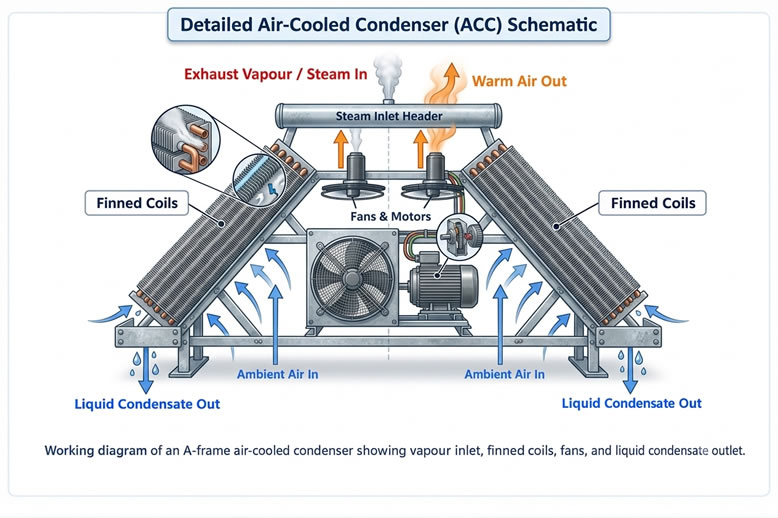
  • Hot vapor enters the coil—refrigerant gas or process steam from the compressor or process system enters the finned-tube coil bundle at high pressure and temperature.
  • Fans draw ambient air across the fins—axial fans, typically mounted below or beside the coil bundle, pull large volumes of ambient air across the finned surface.
  • Heat transfers from vapor to air—As air passes over the fins, heat moves from the hot vapor inside the tubes, through the tube wall and fin surface, into the passing airstream.
  • Vapor condenses to liquid—As enough heat is removed, the vapor condenses into a high-pressure liquid, which then flows out of the condenser and back into the refrigeration or process cycle.
  • Heated air is exhausted—The now-warmer air is discharged away from the unit, typically upward or outward depending on fan configuration, completing the heat rejection cycle.
Air Cooled Condenser

Because this process depends entirely on the temperature difference between the hot coil and the ambient dry-bulb air temperature, ACC performance is governed by dry-bulb temperature—unlike evaporative systems, which are governed by the lower wet-bulb temperature. This is the single most important distinction to understand when comparing the two technologies.


Why Choose an Air-Cooled Condenser?

  • Zero water consumption This is the primary reason facilities choose ACCs. In water-stressed regions of India—and increasingly, across most industrial zones as groundwater regulations tighten—eliminating water dependency for cooling is becoming less of a preference and more of a necessity.
  • Lower maintenance complexity With no water loop, there's no water treatment program to run, no scaling to manage, no biological growth risk, and no bleed-off or makeup water systems to monitor. Maintenance is largely limited to coil cleaning and fan/motor servicing.
  • No risk of water-related equipment damage Water-cooled and evaporative systems face the ongoing risk of coil corrosion and mineral scale buildup from hard water. ACCs avoid this entirely since no water contacts the heat exchange surface.
  • Simpler installation footprint ACCs don't require a water supply line, drain, sump, or water treatment skid—simplifying both initial installation and long-term site planning.
  • Regulatory and environmental alignment As Indian pollution control boards and municipal authorities increasingly restrict groundwater extraction for industrial cooling, ACCs offer a compliance-friendly path that doesn't depend on water allocation approvals.


The Trade-Off: Understanding ACC Limitations

Air-cooled condensers aren't a universal replacement for evaporative or water-cooled systems—they involve a real engineering trade-off that any credible manufacturer should walk you through honestly.

  • Higher condensing temperatures in hot climates Because ACC performance depends on dry-bulb temperature rather than the lower wet-bulb temperature, condensing pressures run higher during India's peak summer months, particularly in regions that regularly exceed 40–45°C. This can mean higher compressor energy draw compared to an evaporative system under the same load.
  • Larger physical footprint for equivalent capacity Air alone transfers heat less efficiently than air-plus-water evaporation, so ACCs typically require a larger coil surface area and higher airflow volumes to reject the same heat load—meaning a bigger unit than an evaporative condenser of comparable capacity.
  • Fan energy and noise ACCs rely on larger or more numerous fans to move sufficient air volume, which can mean higher fan motor energy consumption and greater noise output than water-assisted systems, particularly at full load.

The right choice ultimately depends on your local climate, water availability, space constraints, and the acceptable trade-off between capital cost, water cost, and energy cost over the system's operating life.


Where Air-Cooled Condensers Are Used

  • Power plants ACCs are widely used in steam turbine power generation, particularly at sites where water availability is limited or where environmental clearances restrict water withdrawal for cooling.
  • Oil, gas, and petrochemical processing Refineries and process plants use ACCs extensively for cooling process fluids and refrigerant systems, valuing their reliability and freedom from water treatment logistics in often remote locations.
  • HVAC and commercial refrigeration Rooftop-mounted ACC units are common in commercial buildings, cold storage, and light industrial refrigeration where water supply for cooling isn't readily available or economical.
  • Chemical manufacturing Process cooling in chemical plants often specifies ACCs where water contamination risk or water-related corrosion of process equipment is a concern.
  • Remote and off-grid industrial sites Locations without reliable water infrastructure—such as mining operations or rural processing facilities—rely on ACCs precisely because they don't need a water source to function.


How to Size and Select an Air-Cooled Condenser

Correct sizing depends on several site-specific factors, not just nominal capacity:

  • Design dry-bulb temperature for your location, based on peak summer conditions, not average annual temperature
  • Heat rejection load (TR or kW) calculated from actual system performance data
  • Refrigerant or process fluid type—coil material, tube configuration, and pressure rating vary accordingly
  • Fin material and coating—aluminum fins are standard, but coated or copper fins may be specified in corrosive industrial atmospheres.
  • Fan configuration—induced-draft or forced-draft, single or multi-fan arrangement, depending on airflow requirements and noise constraints
  • Available space and structural support—ACCs generally require more roof or ground area than evaporative units of equivalent capacity.
  • Ambient air quality—dusty or particulate-heavy environments may require additional coil cleaning frequency or specialized fin spacing.

Undersizing results in elevated condensing pressures and compressor strain during peak summer months; oversizing increases capital cost and physical footprint unnecessarily. A proper specification is based on actual heat rejection calculations for your system and location-specific design temperature data.


Maintenance Considerations

Air-cooled condensers are generally lower-maintenance than water-based systems, but they still require a consistent upkeep schedule to sustain rated performance:

  1. Regular cleaning of coil fins to remove dust, debris, and airborne contaminants that reduce airflow and heat transfer
  2. Fan and motor inspection, lubrication, and belt/bearing servicing per manufacturer schedule
  3. Periodic checks of fin condition for bending or damage that restricts airflow
  4. Structural and vibration checks on fan mounts and support frames
  5. Inspection of tube joints and connections for refrigerant leaks

Facilities that maintain a consistent coil-cleaning schedule typically avoid the gradual efficiency loss that comes from fouled fins restricting airflow—a common and preventable cause of underperforming ACC systems.


Choosing a Manufacturer

Before finalizing a supplier for an air-cooled condenser, verify the following:

  1. Coil and fin material specifications and corrosion protection appropriate to your site's atmospheric conditions
  2. Fan and motor efficiency ratings, including availability of variable-speed drives for part-load energy savings
  3. Structural build quality of the frame and casing
  4. Whether the manufacturer provides performance data calculated for your actual design dry-bulb temperature, rather than generic published capacity charts
  5. Compliance with relevant pressure equipment and refrigeration safety standards
  6. After-sales support, spare parts availability, and commissioning assistance


Frequently Asked Questions

1. How does an air-cooled condenser perform in India's hot summer months?

Performance depends on dry-bulb temperature, so condensing pressure rises during peak summer heat, particularly in regions exceeding 40°C. Proper sizing based on your location's actual peak design temperature is essential to avoid undersized systems that struggle during the hottest months.

2. Do air-cooled condensers really eliminate water consumption entirely?

Yes—unlike evaporative or water-cooled systems, ACCs use no water anywhere in the heat rejection process, making them the preferred choice for water-scarce or water-restricted industrial sites.

3. What refrigerants and fluids work with air-cooled condensers?

ACCs are compatible with most common refrigerants and process fluids, including ammonia, R404A, R134a, and various hydrocarbons, provided the coil material and pressure rating are matched to the specific fluid's properties.

4. How much roof or ground space does an air-cooled condenser need compared to an evaporative unit?

ACCs typically require a larger footprint for equivalent capacity, since air alone transfers heat less efficiently than air-plus-water evaporation, meaning more coil surface area and airflow volume are needed to reject the same heat load.

5. Are air-cooled condensers noisier than evaporative or water-cooled systems?

They can be, since ACCs rely on larger or more numerous fans to move sufficient air volume without water assistance. Noise-sensitive installations should specify low-noise fan options or variable-speed drives during selection.

6. What's the typical lifespan of an air-cooled condenser?

With regular coil cleaning and fan maintenance, ACCs commonly operate reliably for 15–20 years, since the absence of a water loop eliminates the corrosion and scaling issues that typically limit the lifespan of water-based systems.

7. Can an air-cooled condenser be retrofitted to replace a water-cooled system?

In many cases, yes—but it requires re-evaluating condensing temperature assumptions, compressor performance at higher condensing pressures, and available space, since ACCs generally need a larger footprint than the water-cooled equipment they're replacing.


Conclusion

Air-cooled condensers have become an essential cooling solution for Indian industries facing water scarcity, tightening environmental regulations, and rising water treatment costs. By rejecting heat directly to ambient air, they eliminate water dependency entirely—trading some thermal efficiency in extreme heat for dramatically simpler operation, lower maintenance complexity, and freedom from water-related corrosion and scaling risks.

The right fit depends on your local climate, available space, and how much weight you place on water independence versus peak-season energy efficiency. A proper sizing calculation based on your actual design dry-bulb temperature—not generic capacity charts—is the difference between a system that performs reliably through Indian summers and one that struggles under real-world conditions.


Looking for an air cooled condenser sized correctly for your site and climate?