

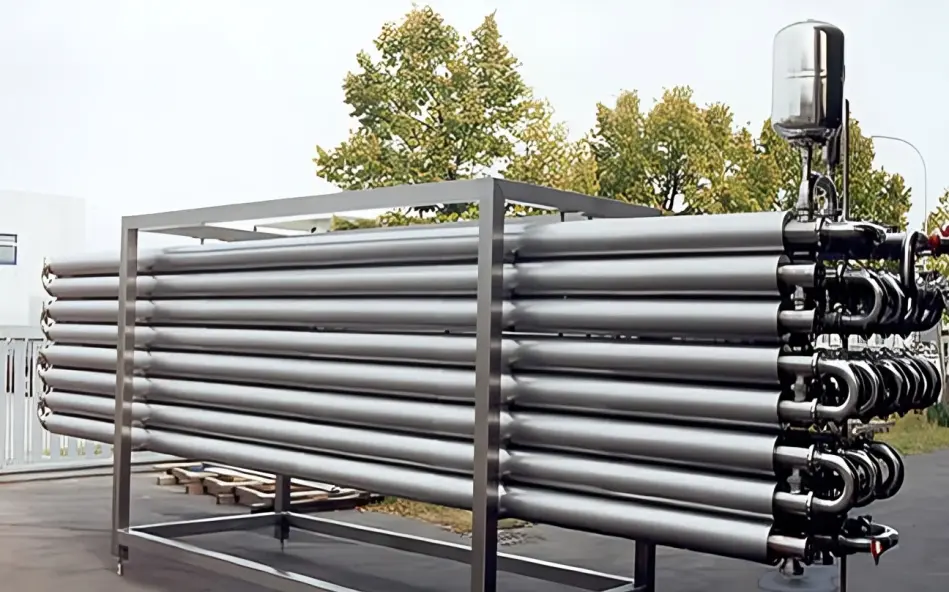
A double-pipe heat exchanger is the simplest and most compact heat exchanger design available for industrial thermal applications. It consists of two concentric pipes — one fluid flows through the inner pipe while the second fluid flows through the annular space between the two pipes, transferring heat through the inner pipe wall without allowing the two fluids to mix. Even though it has a simple design, the double-pipe heat exchanger provides dependable heat transfer for small to medium industrial needs in areas like chemical processing, power generation, food manufacturing, and HVAC around the world. United Cooling Systems Pvt. Ltd.,, manufactures custom double-pipe heat exchangers to ASME and TEMA standards — built for long-term reliable performance across all major industrial applications in India and export markets.
🔍 Related Heat Exchanger Products
Double Pipe Heat Exchanger Applications
Double-pipe heat exchangers serve critical thermal duties across multiple industries:
- Chemical Industries — solvent heating, reactor feed preheating, and product stream cooling
- Power Plants — lube oil cooling, seal water cooling, and auxiliary fluid temperature control
- Food Processing — pasteurization, product heating, and clean-in-place heat recovery
- HVAC Systems — small-capacity building heating and cooling, chiller auxiliaries
- Pharmaceutical Manufacturing — sterile fluid heating and precise temperature control
- Pilot Plants — laboratory-scale thermal testing and process development
Advantages and Limitations
Advantages
- Simplest construction of all heat exchanger types — easy to fabricate and install
- Fully accessible for mechanical cleaning on both the inner pipe and annulus
- Handles high-pressure and high-temperature duties effectively
- Suitable for viscous, fouling, and corrosive process fluids
- Easy to add capacity by connecting additional hairpin sections in series
- Low capital cost for small thermal duties
Limitations
- Not economical for large-scale thermal duties — requires many sections in series
- Higher pressure drop compared to shell and tube heat exchangers
- Limited heat transfer area per unit of installed length
- Large physical footprint when multiple sections are required in series
- Higher fabrication cost per unit area compared to plate heat exchangers
Double-Pipe Heat Exchanger Construction
Inner and Outer Pipes
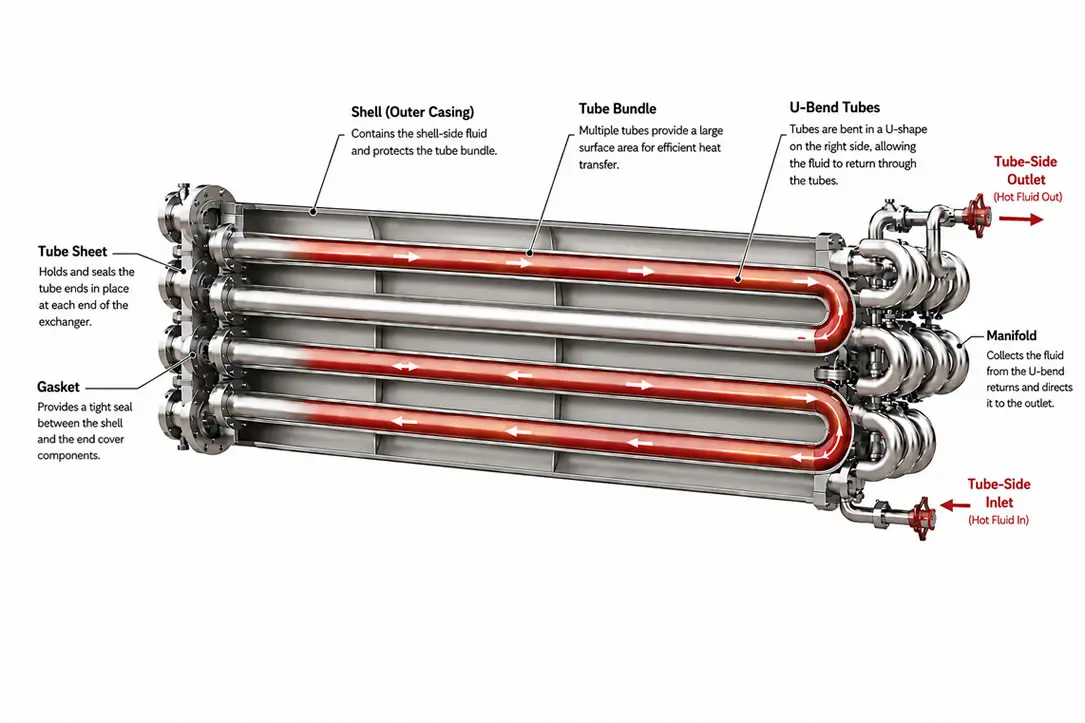
The construction consists of two concentric cylindrical pipes. The inner pipe carries one process fluid while the annular space between the inner and outer pipes carries the second fluid. Both pipes are connected at each end through return bends or U-bends, forming the characteristic hairpin shape.
The outer pipe acts as a pressure boundary for the annulus-side fluid. Both pipes are supported by saddle brackets or mounting frames. The hairpin configuration allows multiple sections to be connected in series to achieve the required heat transfer area for any given thermal duty.
Materials Used
| Component | Material Options |
|---|---|
| Inner Pipe | Carbon Steel, SS304, SS316, Titanium, Copper |
| Outer Pipe | Carbon Steel, SS304, SS316 |
| Return Bends | Same as pipe material |
| Gaskets | PTFE, Graphite, Spiral Wound |
| Fittings | Flanged or Screwed connections |
Material selection is driven by fluid chemistry, operating temperature, pressure rating, and corrosion requirements specific to each application.
Flow Arrangements
Three flow arrangements are possible in double-pipe heat exchangers:
- Counterflow — hot and cold fluids travel in opposite directions through the exchanger. This maintains the strongest temperature difference across the full exchanger length — delivering the highest thermal efficiency of all three arrangements and the closest temperature approach between both streams.
- Parallel Flow — occurs when two fluids enter from the same end and move in the same direction. The temperature difference decreases along the flow path, resulting in lower thermal efficiency than counterflow. Used only in specific applications where controlled outlet temperature is required.
- Cross Flow — rarely applied in double-pipe configurations due to geometric constraints. Occasionally used in modified designs for specific process requirements.
Working Principle of Double-Pipe Heat Exchanger
Heat Transfer Mechanism
Heat transfer in a double pipe exchanger occurs through three sequential mechanisms working together continuously:
- Convection from the hot fluid to the inner pipe wall
- Conduction through the metallic inner pipe wall itself
- Convection from the inner pipe wall to the cold fluid flowing in the annulus
The rate of heat transfer depends directly on the temperature difference between both fluids, the overall heat transfer coefficient of the system, and the total available heat transfer surface area.
Temperature Profiles
In counterflow operation, both fluid temperatures change gradually along the exchanger length — the hot fluid temperature decreases while the cold fluid temperature increases in the opposite direction. This arrangement maintains a consistently strong temperature-driving force from inlet to outlet — which is why counterflow always delivers higher efficiency than parallel flow for the same exchanger size.
In parallel flow operation, the temperature difference is highest at the inlet end and decreases progressively toward the outlet, limiting the maximum achievable heat recovery.
Effectiveness of Flow Arrangements
| Flow Arrangement | Thermal Efficiency | Recommended Use |
|---|---|---|
| Counterflow | Highest — up to 100% theoretical | Most industrial applications |
| Parallel Flow | Moderate — limited by outlet temperature | Controlled temperature duties |
| Cross Flow | Variable | Specialized modified designs |
Design Considerations
Heat Transfer Area
The required heat transfer area is calculated from the basic heat exchanger equation:
Q = U × A × ΔTlm
Where Q is the heat duty, U is the overall heat transfer coefficient, A is the heat transfer surface area, and ΔTlm is the log mean temperature difference. Increasing any one of these three factors directly increases the thermal capacity of the exchanger.
Overall Heat Transfer Coefficient
The overall heat transfer coefficient U combines the individual resistances of tube-side convection, tube wall conduction, annulus-side convection, and fouling deposits on both surfaces. Higher fluid velocities and turbulent flow conditions significantly improve U, which is why maintaining adequate flow velocity in both circuits is critical to performance.
Pressure Drop
Pressure drop increases with fluid velocity and exchanger length. The double pipe design typically produces higher annulus-side pressure drop than equivalent shell and tube designs due to the restricted flow geometry. This must be evaluated carefully during design to ensure the available pump or compressor head is sufficient for the full operating range.
Fouling Factors
TEMA fouling resistance values must be included in all thermal design calculations. Fouling effectively reduces the overall heat transfer coefficient over time — so the exchanger must be intentionally oversized at the design stage to maintain acceptable performance between scheduled cleaning intervals.
Performance Analysis
Log Mean Temperature Difference (LMTD) Method
The LMTD method calculates the effective average temperature difference driving heat transfer across the full exchanger length. For counterflow:
ΔTlm = (ΔT1 − ΔT2) ÷ ln(ΔT1 ÷ ΔT2)
Where ΔT1 and ΔT2 are the temperature differences between both fluids at each end of the exchanger. A higher LMTD value means more driving force available — and a more compact, cost-effective exchanger for the same thermal duty.
Effectiveness-NTU Method
The Effectiveness-NTU method evaluates how efficiently the exchanger uses its available heat transfer capacity. Effectiveness is defined as the ratio of actual heat transfer to the theoretical maximum possible heat transfer. Higher NTU values indicate more heat transfer units — achieved by increasing exchanger length or improving the overall heat transfer coefficient.
Efficiency and Effectiveness
Counterflow double pipe heat exchangers consistently achieve the highest effectiveness values. For equal flow rates of fluids with similar heat capacities, counterflow effectiveness can theoretically approach 100% — making it the most thermally efficient configuration available in any heat exchanger geometry.
Comparison Tables
Double-Pipe vs. Shell-and-Tube Heat Exchanger
| Parameter | Double-Pipe | Shell-and-Tube |
|---|---|---|
| Heat duty range | Low to moderate | Moderate to very high |
| Footprint | Compact for small duty | Larger, scales with duty |
| Maintenance | Simple — pipes dismantle individually | Requires tube bundle removal |
| Pressure drop | Higher per unit area | Lower with proper baffling |
| Best suited for | Small flow rates, single fluid pair | Large flow rates, high pressure/temperature |
| Relative cost (small duty) | Lower | Higher |
| Relative cost (large duty) | Higher (many sections needed) | Lower (scales efficiently) |
Double-Pipe vs. Plate Heat Exchanger
| Parameter | Double-Pipe | Plate Heat Exchanger |
|---|---|---|
| Heat transfer area per volume | Lower | Higher |
| Thermal efficiency | Moderate | High |
| Fouling resistance | Better with high-viscosity/particulate fluids | More prone to fouling, needs frequent cleaning |
| Pressure rating | Suited to higher pressures | Limited by gasket/plate rating |
| Maintenance | Tool-free pipe disassembly | Requires full disassembly of plate pack |
| Best suited for | High-pressure, viscous, or fouling-prone fluids | Clean fluids, frequent cleaning cycles, space-constrained sites |
Why Choose United Cooling Systems Pvt. Ltd.
As a trusted double-pipe heat exchanger manufacturer in India, United Cooling Systems Pvt. Ltd. delivers:
- ✅ Complete In-House Design and Manufacturing — every unit designed, fabricated, and tested under one roof
- ✅ ASME and TEMA Standard Compliance — full international certification on every unit supplied
- ✅ All Materials Available — carbon steel, SS304, SS316, titanium, copper, and special alloys
- ✅ Full Mechanical Cleaning Access — both inner pipe and annulus are fully accessible for maintenance
- ✅ Competitive Indian Manufacturing Prices — without compromising material quality or weld standards
- ✅ Reliable On-Time Delivery — across all order sizes throughout India and export markets
- ✅ Proven Cross-Industry Experience — chemical, power, food, pharmaceutical, and HVAC industries
Frequently Asked Questions
What is a double-pipe heat exchanger?
A double-pipe heat exchanger transfers heat between two fluids through the wall of an inner pipe — one fluid flows inside the inner pipe, and the other flows in the annular space between the inner and outer pipes.
Which flow arrangement is most efficient?
Counterflow is the most thermally efficient arrangement — it maintains the strongest temperature difference across the full exchanger length, delivering maximum heat recovery.
When should I choose a double pipe over a shell and tube?
Choose double pipe for small to medium thermal duties, high-pressure applications, viscous or fouling fluids, and installations where simple mechanical cleaning access is essential.
What materials are available?
Carbon steel, stainless steel (SS304 and SS316), titanium, copper, copper-nickel alloys, and special high-alloy materials for aggressive chemical services.
How is a double-pipe heat exchanger cleaned?
Both the inner pipe bore and the annulus are fully accessible for mechanical cleaning using brushes, rods, or high-pressure water jetting — making maintenance straightforward.
What is the typical service life?
A properly maintained double-pipe heat exchanger delivers reliable service for 15 to 25 years depending on material selection and operating conditions.
Conclusion
Double-pipe heat exchangers remain the most practical and cost-effective thermal solution for small- to medium-capacity industrial duties — combining simple construction, high-pressure capability, full cleaning access, and long service life in one reliable design. From chemical processing and power generation to food manufacturing and HVAC systems — wherever a compact, maintainable, and dependable heat exchanger is required, the double-pipe design consistently delivers proven results. United Cooling Systems Pvt. Ltd., Coimbatore, manufactures custom double-pipe heat exchangers to ASME and TEMA standards — engineered for 15 to 25 years of reliable industrial service with minimal maintenance requirements.
Request a Custom Double Pipe Heat Exchanger Quote Today →

