


What Is a Water Cooling Tower?
A water cooling tower is a critical component for efficient heat rejection, water conservation, and cost control across power plants, HVAC systems, and manufacturing facilities. Choosing the right type and understanding how it works directly impacts operational efficiency and sustainability.
Proper design, installation, and regular maintenance maximize a cooling tower's performance and lifespan while minimizing environmental impact and operating expenses. As industries prioritize sustainability, water cooling towers remain essential for reliable, long-term thermal management.
United Cooling Systems engineers custom water cooling towers built for efficiency, durability, and low lifecycle cost.
How Does a Water Cooling Tower Work?
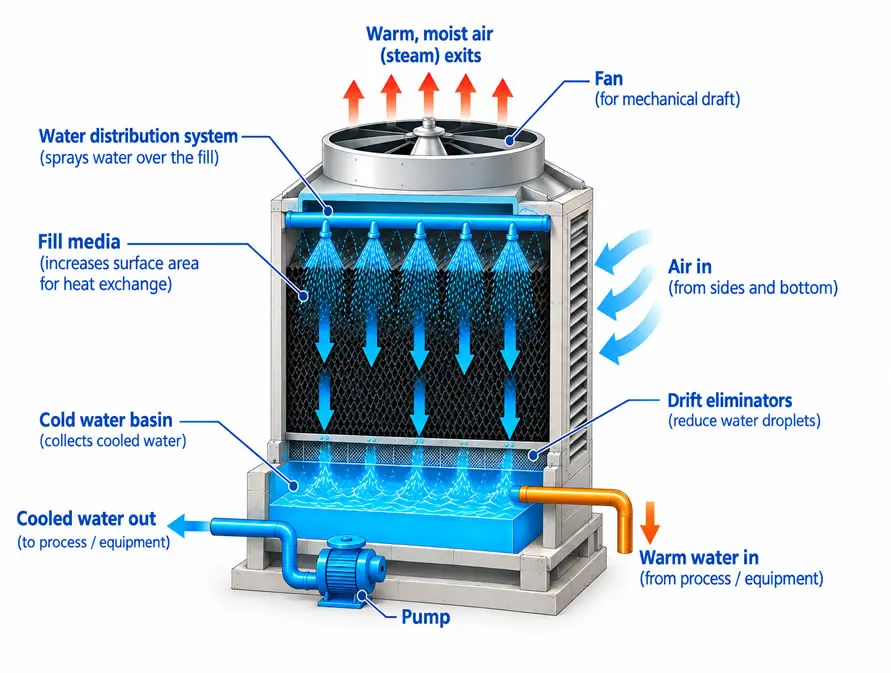
Understanding the working mechanism of a cooling tower helps clarify why it is so effective at heat removal. The process generally involves the following steps:
- Hot Water Enters the Tower: Water heated by industrial processes or air conditioning systems is pumped into the top of the cooling tower.
- Water Distribution: The hot water is distributed evenly across a fill or packing material inside the tower. This fill increases the surface area of the water, allowing for better contact with air.
- Air Contact and Evaporation: As water flows down through the fill, air is drawn or forced through the tower—either naturally or mechanically using fans. A small percentage of the water evaporates during this process, which absorbs heat from the remaining water and cools it down.
- Cooled Water Collection: The cooled water collects at the bottom of the tower in a basin and is then pumped back into the system to absorb more heat, completing the cycle.
- Heat and Moisture Release: The warm, moist air generated during evaporation is expelled from the top of the tower into the atmosphere.
This continuous cycle allows facilities to reuse water efficiently while maintaining optimal operating temperatures for machinery and equipment.
Types of Water Cooling Towers
Water cooling towers come in various designs, each suited to specific industrial needs, water flow requirements, and space constraints. Here are the most common types:
1. Natural Draft Cooling Towers
Natural draft cooling towers rely on the natural buoyancy of warm air to create airflow through the tower. These towers are typically large, hyperbolic structures often seen at power plants. As hot air rises naturally, it draws cooler air in from the bottom, eliminating the need for mechanical fans. While natural draft towers require significant capital investment and space, they are highly efficient for large-scale operations and have lower operating costs due to reduced reliance on mechanical components.
2. Mechanical Draft Cooling Towers
Mechanical draft cooling towers use fans to force or induce airflow through the tower. These are further categorized into two types:
- Forced Draft Cooling Towers: In this design, fans are located at the base of the tower and push air upward through the falling water. Forced draft towers are known for their durability and are less prone to recirculation issues, but they can be noisier and consume more energy.
- Induced Draft Cooling Towers: These towers have fans installed at the top, which pull air through the tower. Induced draft towers are more common in industrial applications because they offer better air distribution and reduce the chances of hot air recirculation.
3. Crossflow Cooling Towers
In crossflow cooling towers, air flows horizontally across the falling water, while water moves vertically downward through the fill media. This design allows for easier maintenance since the fill is accessible from the sides, and it generally requires a lower pump head, which can reduce energy consumption.
4. Counterflow Cooling Towers
Counterflow cooling towers feature air flowing vertically upward, directly opposite to the downward flow of water. This design maximizes heat transfer efficiency since air and water move in opposite directions, ensuring maximum contact time. However, counterflow towers usually require higher pump pressure, and maintenance access can be more challenging compared to crossflow designs.
5. Open Circuit (Direct Contact) Cooling Towers
In open circuit cooling towers, the water being cooled comes into direct contact with the air. This is the most common and cost-effective type, widely used in HVAC systems and light industrial applications. However, since the water is exposed to air, it is more susceptible to contamination, requiring regular water treatment.
6. Closed Circuit (Indirect) Cooling Towers
Closed-circuit cooling towers isolate the process fluid from the outside air by circulating it through a closed coil system. Water is sprayed over the coil externally to facilitate evaporative cooling, while the internal fluid remains uncontaminated. This type is ideal for applications where water purity is critical, such as in pharmaceutical or food processing industries, though it typically comes with higher upfront costs.
Key Components of a Water Cooling Tower
To fully understand how a cooling tower operates, it helps to know its main components:
- Fill or Packing Material: Increases surface area for better heat exchange between air and water.
- Fans: Used in mechanical draft towers to control airflow (axial or centrifugal fans).
- Drift Eliminators: Prevent water droplets from escaping with the exhaust air, minimizing water loss.
- Basin: Collects cooled water at the bottom of the tower before recirculation.
- Water Distribution System: Ensures even spread of hot water across the fill material.
- Casing and Structure: Provides structural support and houses internal components, typically made from FRP (fiber-reinforced plastic), wood, or concrete.
Benefits of Using a Water Cooling Tower
Water cooling towers offer several advantages that make them indispensable in industrial settings:
Water Conservation
By allowing water to be reused multiple times instead of discharging it after a single pass, cooling towers significantly reduce water consumption—an increasingly important factor as industries face growing regulatory pressure and water scarcity concerns.
Energy Efficiency
Cooling towers help maintain equipment at optimal operating temperatures, which improves overall energy efficiency. Machinery running within recommended temperature ranges consumes less energy and experiences less wear and tear.
Cost Savings
Reduced water and energy consumption translate directly into lower operational costs. Over time, the investment in a well-designed cooling tower pays for itself through these efficiency gains.
Improved Equipment Lifespan
Consistent and effective cooling prevents overheating, which can extend the lifespan of industrial equipment, HVAC systems, and manufacturing processes, reducing the frequency of costly repairs and replacements.
Environmental Benefits
By minimizing water waste and improving energy efficiency, cooling towers contribute to a facility's overall sustainability goals, helping reduce carbon footprints and supporting compliance with environmental regulations.
Common Applications of Water Cooling Towers
Water cooling towers are used across a wide range of industries and applications, including:
- Power Plants: To cool steam turbine condensers and maintain efficient electricity generation.
- HVAC Systems: In commercial buildings, hospitals, and shopping malls for centralized air conditioning.
- Manufacturing Plants: To cool machinery, hydraulic systems, and industrial processes.
- Oil Refineries and Petrochemical Plants: For cooling various process fluids and equipment.
- Data Centers: To manage heat generated by servers and IT infrastructure.
- Food and Beverage Industry: For process cooling while maintaining hygiene standards.
Maintenance Tips for Water Cooling Towers
Proper maintenance is essential to ensure a cooling tower operates efficiently and has a long service life. Here are some key maintenance practices:
- Regular Water Treatment: Prevent scale buildup, corrosion, and biological growth (such as algae and bacteria, including Legionella) through consistent water treatment programs.
- Routine Inspection: Check fill media, fans, motors, and belts regularly for wear and damage.
- Cleaning the Basin: Remove debris and sediment from the basin periodically to maintain water quality and prevent clogging.
- Drift Eliminator Checks: Ensure drift eliminators are functioning properly to minimize water loss and maintain efficiency.
- Fan and Motor Servicing: Lubricate bearings and inspect motors to prevent mechanical failures that could disrupt cooling operations.
- Monitor Water Chemistry: Regularly test pH levels, conductivity, and chemical concentrations to prevent corrosion and scaling issues.
Choosing the Right Water Cooling Tower for Your Needs
Selecting the appropriate cooling tower depends on several factors, including the heat load requirements, available space, water quality, budget, and specific industry needs. Facilities with large-scale operations and consistent heat loads may benefit from natural draft towers, while smaller commercial buildings often find mechanical draft or crossflow towers more practical and cost-effective.
It's also important to consider factors like noise restrictions, local climate conditions, and water treatment requirements when selecting a cooling tower design. Consulting with a cooling tower specialist or engineer can help ensure the chosen system aligns with both performance requirements and long-term operational goals.
Frequently Asked Questions
1. What is the purpose of a water cooling tower?
A water cooling tower removes excess heat from water used in industrial processes, power generation, and HVAC systems by exposing it to ambient air, primarily through evaporation, allowing the water to be cooled and reused continuously.
2. What is the operation of a water cooling tower?
Hot water enters the top of the tower and is distributed across a fill material to increase surface area. Air flows through the tower — naturally or via fans — causing a small portion of the water to evaporate, which cools the remaining water. After cooling, the water gathers in a basin at the bottom and is then recycled back into the system.
3. What's the difference between natural draft and mechanical draft cooling towers?
Natural draft towers rely on the natural buoyancy of warm air to create airflow and require no fans, making them efficient for large-scale operations but costly to build. Mechanical draft towers use fans to force or induce airflow and are more common in small- to mid-sized industrial and commercial applications.
4. What's the difference between crossflow and counterflow cooling towers?
In crossflow towers, air moves horizontally across the falling water, making the fill easier to access for maintenance. In counterflow towers, air moves vertically upward against the falling water, which maximises heat transfer efficiency but requires higher pump pressure and offers less convenient maintenance access.
5. What's the difference between open-circuit and closed-circuit cooling towers?
In open-circuit towers, the process water contacts the air directly, making them cost-effective but more prone to contamination. In closed-circuit towers, the process fluid stays sealed inside a coil while water is sprayed externally for evaporative cooling — ideal where fluid purity matters, such as in pharmaceutical or food processing applications.
6. What are the main components of a water cooling tower?
Key components include the fill or packing material, fans (in mechanical draft towers), drift eliminators, the basin, the water distribution system, and the casing/structure, typically built from FRP, wood, or concrete.
7. What maintenance does a water cooling tower need?
Regular maintenance includes water treatment to prevent scale, corrosion, and biological growth (including Legionella); routine inspection of fill, fans, motors, and belts; basin cleaning; drift eliminator checks; fan and motor servicing; and monitoring water chemistry such as pH and conductivity.
8. How do I choose the right cooling tower for my facility?
Selection depends on heat load requirements, available space, water quality, budget, and industry-specific needs. Large-scale, consistent heat loads often suit natural draft towers, while smaller commercial buildings typically do better with mechanical draft or crossflow designs. Noise restrictions and local climate should also factor into the decision.
9. What industries use water cooling towers?
Water cooling towers are used in power plants, HVAC systems for commercial buildings, manufacturing plants, oil refineries and petrochemical plants, data centres, and food and beverage processing facilities.
10. Why is water conservation a key benefit of cooling towers?
Cooling towers allow water to be reused multiple times instead of being discharged after a single pass, significantly reducing overall water consumption — an important advantage given increasing regulatory pressure and water scarcity concerns.
Conclusion
A water cooling tower is far more than just an industrial accessory—it is a critical component that enables efficient heat management, water conservation, and cost savings across countless industries. Whether you're operating a power plant, managing an HVAC system, or running a manufacturing facility, understanding how cooling towers work and selecting the right type for your needs can significantly enhance operational efficiency and sustainability.
By investing in proper design, installation, and regular maintenance, businesses can maximize the performance and lifespan of their water cooling towers while minimizing environmental impact and operational costs. As industries continue to prioritize sustainability and resource efficiency, water cooling towers will remain a cornerstone technology for effective thermal management for years to come.
Need a Cooling Tower Built for Your Facility's Exact Heat Load?
Request a Free Consultation →

