


Industrial cooling systems are under more pressure than ever to deliver higher performance while using less water, less energy, and fewer chemicals. Evaporative closed-circuit coolers have emerged as the answer for facilities that need dependable heat rejection without compromising process fluid purity. Unlike traditional open cooling towers, these systems keep your process fluid completely isolated from the atmosphere, combining the cooling power of evaporation with the protection of a sealed loop.
Whether you're running a power plant, a pharmaceutical facility, a plastics extrusion line, or a data center, understanding how evaporative closed-circuit coolers work—and why they consistently outperform older cooling technologies—can help you make a smarter investment in your facility's thermal management infrastructure.
This guide covers everything you need to know: what evaporative closed-circuit coolers are, how they operate, their key advantages, where they're used, and how to choose the right system for your application.
What Is an Evaporative Closed Circuit Cooler?
An evaporative closed-circuit cooler, sometimes called a closed-loop cooling tower, is a HeatExchanger system in which the process fluid — water, glycol, oil, or another heat-transfer medium — circulates through a sealed coil rather than being exposed directly to open air or spray water. Outside the coil, a separate water circuit continuously wets the coil surface while a fan draws air across it. As the wetting water evaporates, it pulls heat from the coil, which in turn cools the enclosed process fluid inside.
This design gives you the efficiency benefits of evaporative cooling — where evaporation removes far more heat per unit of water than simple air contact — without ever letting the process fluid touch outside air, dust, or untreated water. The result is a hybrid system that behaves thermally like an open cooling tower but protects fluid quality like a closed dry cooler.
Because the two water systems (the sealed process loop and the open spray/evaporative loop) never mix, evaporative closed-circuit coolers are especially important in cases where keeping the fluid clean is vital for product quality, equipment longevity, or compliance with where keeping the fluid clean is crucial for product quality, equipment lifespan, or following regulations.
How Evaporative Closed Circuit Coolers Work
The operating principle can be broken down into a few clear stages:
- Process fluid enters the coil. Hot fluid from your process—a chiller, an injection molding machine, a furnace, or a reactor jacket—flows into a serpentine coil bundle inside the unit.
- Water cascades over the coil. A recirculating spray water system continuously wets the exterior of the coil, forming a thin film across the tube surface.
- Air is drawn across the wetted coil. An axial or centrifugal fan pulls ambient air through the unit, passing it across the wetted coil surface.
- Evaporation removes heat. As a portion of the spray water evaporates into the passing airstream, it extracts latent heat from the coil wall—and therefore from the process fluid flowing inside it.
- Cooled fluid returns to the process. The now-cooled process fluid exits the coil and returns to your system, ready to absorb more heat in the next cycle.
- Drift eliminators capture water carryover. Before exiting the unit, air passes through drift eliminators that minimize water loss and keep the surrounding area dry.
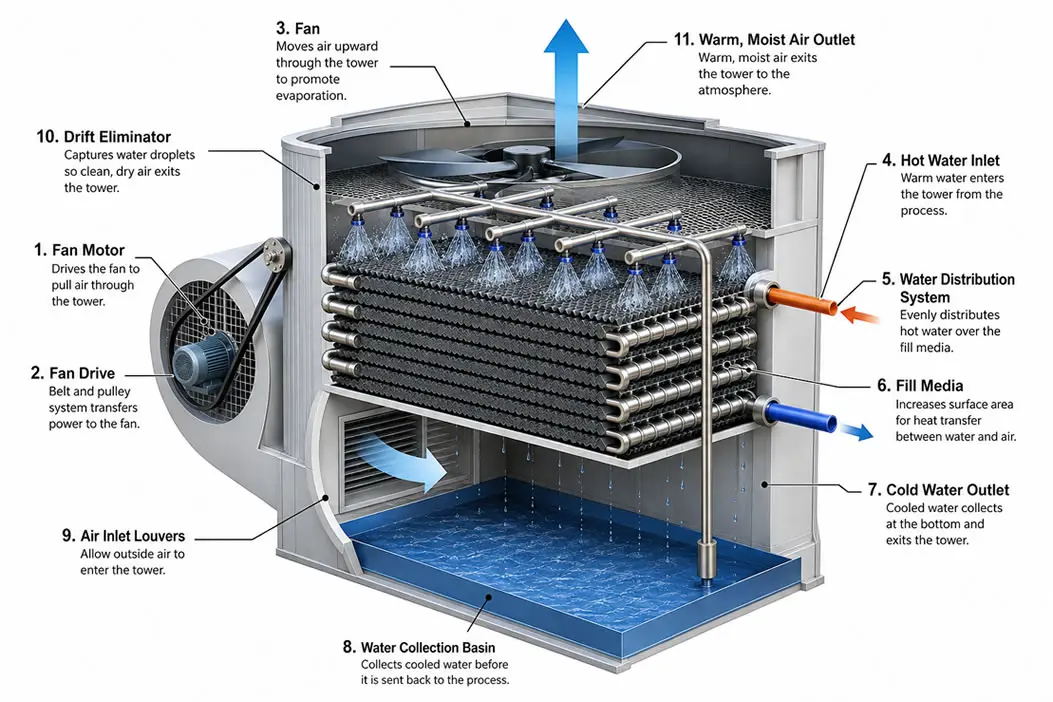
This closed-loop separation is the defining feature that distinguishes evaporative closed circuit coolers from traditional open cooling towers, where the process water itself is exposed directly to air, dust, and biological growth.
Key Advantages of Evaporative Closed Circuit Coolers
1. Complete Process Fluid Protection
Because the process fluid never contacts outside air or untreated water, it stays free from contamination, dust ingress, and biological fouling. This translates directly into longer equipment life, fewer unplanned shutdowns, and significantly reduced fouling inside downstream heat exchangers, chillers, and piping.
2. Better Cooling Results When Compared to Dry Coolers
Because evaporation is a far more efficient heat-rejection mechanism than simple air convection, evaporative closed-circuit coolers can achieve lower approach temperatures than air-cooled (dry) systems of a similar footprint. This makes them ideal for high heat-load applications and facilities operating in hot climates where dry coolers alone would struggle to hit target temperatures.
3. Lower Water Consumption Than Open Cooling Towers
While evaporative closed-circuit coolers do use water for the spray circuit, they typically consume less water overall than traditional open cooling towers, since there's no need for the aggressive blowdown and treatment cycles required to manage a fully exposed process water loop.
4. Reduced Chemical Treatment Requirements
Since the process fluid is sealed away from the atmosphere, it requires far less ongoing chemical treatment than an open loop. The spray water circuit still needs standard water treatment, but the sealed side of the system stays clean with minimal intervention—cutting chemical costs and reducing environmental impact.
5. Energy-Efficient Operation
Modern units typically use variable-speed EC or axial fan motors, allowing the system to modulate airflow based on real-time cooling demand rather than running at full capacity continuously. This alone can meaningfully cut electricity consumption across a full operating year, especially in climates with wide seasonal temperature swings.
6. Compact, Space-Efficient Footprint
Evaporative closed-circuit coolers are engineered to deliver high thermal capacity in a relatively small footprint, which makes them a practical choice for facilities with limited rooftop or yard space, or for retrofit projects where a large open cooling tower simply won't fit.
7. Reduced Maintenance and Downtime
With less fouling, less scaling, and less biological growth risk inside the sealed loop, these systems generally require less frequent cleaning and inspection of the process-side components—translating into lower long-term maintenance expenses and fewer production interruptions.
Evaporative Closed Circuit Coolers vs. Traditional Open Cooling Towers
| Factor | Closed Circuit Cooler | Open Cooling Tower |
|---|---|---|
| Fluid exposure | Sealed, never contacts air | Directly exposed to atmosphere |
| Fouling & scaling risk | Low | High |
| Water usage | Lower | Higher |
| Chemical treatment | Minimal on process side | Continuous, higher volume |
| Maintenance | Reduced | Frequent |
| Equipment lifespan | Longer | Shorter, due to exposure |
| Footprint | Compact | Larger |
| Legionella risk | Lower | Higher, requires active management |
This comparison makes clear why industries handling sensitive processes, high-value equipment, or strict hygiene standards increasingly choose closed-circuit systems over conventional open towers, even though the upfront investment can be slightly higher.
Industries and Applications
Evaporative closed-circuit coolers are used across a wide range of industrial and commercial sectors, including:
- Power generation and energy facilities where reliable, continuous heat rejection is critical to turbine and generator cooling systems.
- Chemical and pharmaceutical plants where fluid purity directly affects product safety and regulatory compliance.
- Plastics injection molding and extrusion where consistent mold temperatures are essential for part quality and cycle time.
- Food and beverage production where hygiene standards make sealed-loop systems preferable to open water exposure.
- Metalworking, foundries, and forging operations where high heat loads demand dependable, high-capacity cooling.
- Data centers and IT infrastructure where precision temperature control protects sensitive electronic equipment.
- HVAC systems for large commercial and industrial buildings where energy efficiency and reliability both matter.
- Process refrigeration systems supporting cold storage, chillers, and industrial freezing applications.
In each of these settings, the combination of clean fluid handling, high thermal performance, and reduced operating cost makes evaporative closed-circuit coolers a practical long-term investment rather than just an upfront capital expense.
How to Pick the Best Closed Circuit Evaporative Cooler
Selecting the correct unit for your facility depends on several interrelated factors:
- Heat load and required approach temperature.The system must be sized to reject your actual peak heat load while achieving the target fluid outlet temperature under your local design wet-bulb conditions.
- Fluid type and flow rate. Water, glycol mixtures, and process oils all behave differently thermally, and the coil design should reflect your actual fluid properties and required flow.
- Ambient conditions. Local climate—particularly design wet-bulb temperature—directly affects unit sizing, since evaporative cooling performance is closely tied to ambient humidity.
- Water quality and treatment capability. Since the spray water circuit is still exposed to air, your facility's water treatment program needs to account for scaling, biological growth, and drift control.
- Material selection. Coil and casing materials should match the corrosiveness of your environment—coastal or chemical-processing sites, for example, typically need epoxy-coated or stainless-steel construction.
- Available space and installation constraints. Footprint, structural loading, noise limits, and access for maintenance should all factor into unit selection and placement.
- Energy efficiency requirements. Variable-speed fan options and efficient coil designs can significantly reduce lifetime operating costs, even if the initial investment is slightly higher.
Working with an experienced manufacturer who can model your specific heat load, ambient conditions, and fluid characteristics ensures you get a properly sized system rather than an oversized or undersized unit that wastes energy or fails to meet performance targets.
Conclusion
Evaporative closed-circuit coolers represent one of the most reliable and efficient solutions available for industrial heat rejection today. By combining the cooling power of evaporation with the fluid protection of a fully sealed loop, these systems deliver lower operating temperatures, reduced water and chemical consumption, longer equipment life, and a smaller physical footprint compared to traditional open cooling towers. For industries where process fluid purity, energy efficiency, and long-term reliability matter — from power generation and pharmaceuticals to plastics, food processing, and data centers — evaporative closed circuit Coolers provide a tried-and-true route to more economical, intelligent, and clean cooling. If your facility is evaluating a new cooling system or looking to upgrade from an aging open cooling tower, now is the right time to explore whether a closed-circuit solution fits your operating requirements.
Frequently Asked Questions
1. What is an evaporative closed-circuit cooler used for?
It rejects heat from industrial process fluids like water, glycol, or oil while keeping the fluid sealed and protected from contamination, making it ideal for sensitive, high-value processes.
2. What distinguishes a cooling tower from a closed-circuit cooler?
A closed-circuit cooler keeps process fluid inside a sealed coil, never exposing it to air, unlike open cooling towers where process water directly contacts the atmosphere.
3. Do evaporative closed-circuit coolers use less water?
Yes, generally. Because the process loop is sealed, less blowdown and treatment water is needed compared to fully open, conventional cooling tower systems.
4. What materials are used in closed-circuit coolers?
Common materials include galvanized steel, stainless steel, and epoxy-coated casings, paired with copper or stainless-steel coils depending on the fluid and environment.
5. Are closed-circuit coolers more energy efficient?
Yes, especially with variable-speed fan motors, which adjust airflow to actual cooling demand instead of running continuously at full capacity, cutting energy use.
6. Which industries benefit most from closed-circuit coolers?
Power generation, pharmaceuticals, plastics processing, food and beverage, data centers, and metalworking all benefit from the clean, reliable cooling these systems provide.


