


What is a hairpin-type heat exchanger?
A hairpin-type heat exchanger is a compact industrial heat transfer device designed to efficiently transfer heat between two fluids without allowing them to mix. It typically consists of U-shaped tubes arranged within a shell, creating separate flow paths for hot and cold fluids. The counter-current flow arrangement helps improve temperature efficiency and overall heat transfer performance.
Because of its compact construction, a hairpin heat exchanger requires less installation space compared with many conventional heat exchanger designs. Its robust configuration also makes it suitable for applications involving high temperatures, pressure conditions, and demanding process environments.
Hairpin heat exchangers are widely used in chemical plants, oil and gas facilities, petrochemical industries, power plants, HVAC systems, and other process industries. Their flexibility allows manufacturers to customize the exchanger according to fluid characteristics, operating temperature, pressure, material requirements, and available space, making them an efficient and practical solution for industrial heat transfer applications.
Why Choose a Hairpin-Type Heat Exchanger?
Hairpin heat exchangers offer a range of advantages that make them ideal for industries like chemical processing, oil and gas, HVAC systems, and power generation. Here are the key reasons to choose this solution:
- Compact Design: The U-tube configuration ensures maximum space efficiency, making them perfect for installations where space is limited.
- High Heat Transfer Efficiency: The countercurrent flow increases the temperature difference between the fluids, ensuring effective heat exchange even in very hot and high-pressure situations.
- Durability: Constructed from high-quality materials like stainless steel, titanium, and carbon steel, these heat exchangers are built to withstand extreme temperatures and harsh conditions.
- Low Maintenance: Their simple construction allows for easy maintenance, minimising downtime and reducing long-term operational expenses.
- Customisable Solutions: Tailored to meet specific industrial needs, hairpin heat exchangers can be designed with the right size, capacity, and materials for your application.
When to Use Hairpin Heat Exchangers
- High-Pressure Applications: Use hairpin heat exchangers when working with high-pressure fluids (up to 5000 psi). Their strong double-pipe design makes them perfect for petrochemical and refining operations.
- Fluids That Cause Fouling: When your fluids create buildup or scaling, hairpin exchangers are simple to clean. You can remove the tube bundle for maintenance without stopping the entire system.
- Corrosive and Thick Fluids: You can use different materials for inner and outer pipes to resist corrosion. The design also works well with thick, viscous fluids and slurries.
- Temperature Changes: The U-bend shape handles thermal expansion naturally. This means you don't need extra expansion joints when temperatures vary significantly.
Applications of Hairpin-Type Heat Exchangers
Hairpin-type heat exchangers are widely used across several industries due to their versatility and superior heat transfer capabilities. Common applications include:
- Chemical Processing: Ideal for managing temperature-sensitive reactions in reactors and other chemical processing equipment.
- Oil and Gas: Used for cooling and heating fluids in harsh environments such as oil refineries and offshore platforms.
- HVAC Systems: Efficiently transfer heat in heating, ventilation, and air conditioning systems.
- Power Generation: Applied in cooling systems for power plants and other energy-related applications.
Hairpin Heat Exchanger vs Shell and Tube Heat Exchanger
Choosing between a hairpin and Shell and Tube Heat Exchanger depends on your pressure requirements, available space, and maintenance needs. Here is a quick comparison to help you decide:
| Feature | Hairpin Heat Exchanger | Shell & Tube Heat Exchanger |
|---|---|---|
| Space requirement | ✅ Compact, small footprint — ideal for tight installations | Larger footprint needed |
| Pressure handling | ✅ Up to 5000 psi — suits high-pressure industrial processes | Moderate to high pressure |
| Maintenance | ✅ Easy tube bundle removal — minimal downtime | More complex, higher downtime |
| Thermal expansion | ✅ U-bend absorbs expansion naturally — no extra joints needed | Requires separate expansion joints |
| Fouling / cleaning | ✅ Bundle removable without stopping system | Full shutdown often required |
| Flow arrangement | ✅ True counter-current flow — maximum heat transfer efficiency | Multi-pass, less efficient per pass |
| Best for | High pressure, tight spaces, oil & gas, chemical plants | High volume, large capacity applications |
| Cost | Lower long-term operational cost | Higher initial and maintenance cost |
How Do Hairpin-Type Heat Exchangers Work?
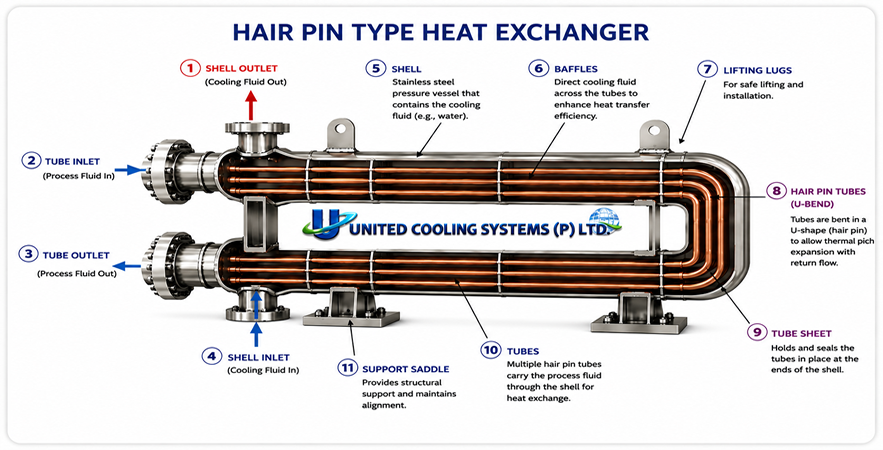
Countercurrent Flow Design
The principle behind a hairpin-type heat exchanger is the countercurrent flow of fluids. Hot fluid flows through the inner U-tube, while cold fluid moves through the surrounding annular space. This opposite direction of flow creates a temperature gradient, enhancing heat transfer and ensuring maximum efficiency.
- Hot Fluid: Flows through the inner tube and loses heat.
- Cold Fluid: Flows in the opposite direction around the tube, absorbing the heat from the hot fluid.
- Temperature Gradient: The continuous difference in temperature between the two fluids along the flow path maximises heat exchange.
Key Features of Hairpin-Type Heat Exchangers
- U-Tube Configuration: The tubes' unique U-shape gives fluids a longer flow path, which increases the surface area for heat transfer and saves space.
- Extended Flow Path Design: The longer flow paths enhance heat transfer efficiency, ensuring effective cooling and heating.
- Low Pressure Drop: Optimised for minimal pressure loss, it reduces the energy required to pump fluids through the system.
- Durable Materials: Constructed using high-performance materials such as stainless steel, titanium, and exotic alloys (e.g., Hastelloy, Inconel) for maximum durability.
Why Choose United Cooling Systems for Hairpin Type Heat Exchangers?
United Cooling Systems is a leading manufacturer and supplier of hairpin-type heat exchangers, offering customised solutions for industries in Coimbatore, Tamil Nadu, and across South India. Our commitment to quality, performance, and customer satisfaction makes us the ideal partner for all your heat exchanger needs.
- Customised Solutions: We design heat exchangers that meet your specific operational requirements, ensuring optimal performance for every application.
- Industry-Leading Expertise: Our team has years of experience in the design, manufacture, and supply of efficient heat exchangers.
- Quality Assurance: We use the highest quality materials and adhere to strict manufacturing standards to deliver reliable, long-lasting products.
- Timely Delivery: We prioritise punctuality and guarantee the timely delivery of your heat exchangers.
- Competitive Pricing: We offer high-performance heat exchangers at affordable prices, delivering excellent value for your investment.
Hairpin Type Heat Exchanger: Technical Specifications
- Heat Transfer Area: The surface area is designed to maximise heat transfer, ensuring the exchanger performs efficiently even with higher temperature gradients.
- Temperature Range: Designed to handle temperatures from -150°C to 800°C, making them suitable for both extreme hot and cold fluids.
- Pressure Rating: High-pressure ratings, often exceeding 200 bar (2900 psi), ensure that hairpin heat exchangers can handle demanding industrial applications.
- Materials of Construction: Stainless steel, carbon steel, titanium, and exotic alloys like Hastelloy are selected based on fluid types and environmental conditions.
Maintenance Best Practices for Hairpin-Type Heat Exchangers
- Regular Inspections: Evaluate tubes, seals, and tube sheets for any signs of corrosion, cracks, or leaks.
- Cleaning and Descaling: Periodically remove fouling and scaling that can reduce heat transfer efficiency.
- Flow and Temperature Monitoring: Keep track of fluid flow and temperature to detect any abnormalities early.
- Seal Replacement: Regularly replace gaskets and seals to prevent fluid leaks.
- Corrosion Protection: Apply protective coatings or cathodic protection to safeguard against corrosive environments.
Frequently Asked Questions (FAQ)
1. How long does a hairpin heat exchanger typically last?
With proper material selection and regular maintenance, a hairpin heat exchanger can operate reliably for 15–20 years or more, even in demanding industrial environments.
2. Can hairpin heat exchangers be customised for my specific process?
Yes. United Cooling Systems designs each unit around your fluid type, temperature range, pressure rating, and available installation space, so no two exchangers are built exactly alike.
3. What capacity and size options are there?
We manufacture hairpin heat exchangers across a wide range of tube lengths, diameters, and bundle configurations to match capacities from small process skids to large industrial installations.
4. How is a hairpin heat exchanger different from a double-pipe heat exchanger?
A hairpin exchanger is essentially a compact evolution of the double pipe design, using a U-bend to fold the flow path back on itself. This reduces the footprint significantly while keeping the same true countercurrent flow advantages.
5. What standards do your hairpin heat exchangers comply with?
Our units are engineered and fabricated to meet applicable industrial codes and quality benchmarks for pressure equipment, ensuring safe and dependable performance across chemical, oil & gas, and power applications.
6. How long does delivery take after placing an order?
Lead times depend on size, materials, and the level of customisation. Contact our team with your specifications for an accurate delivery timeline and quote.


