A structured maintenance program protects thermal performance, prevents unexpected failures, and significantly extends equipment service life.
- High-pressure water jetting removes soft scale and biological deposits from straight tube interiors quickly and effectively.
- Mechanical rodding clears stubborn hard mineral deposits from accessible straight tubes without chemical use.
- Chemical circulation cleaning dissolves crystalline scale inside U-tube bundles where mechanical access is restricted.
- Eddy current testing detects wall thinning and internal defects without dismantling the exchanger.
- Bundle pull and full inspection provide complete visual and dimensional checks at planned intervals.
- Hydrostatic pressure testing verifies full pressure containment integrity after every maintenance intervention and tube repair.
Why Plant Owners and Engineers Choose United Cooling Systems Pvt. Ltd.
As a trusted shell and tube heat exchanger manufacturer in India, United Cooling Systems Pvt. Ltd. delivers precision-engineered thermal equipment built for the most demanding industrial environments.
- Complete In-House Design and Manufacturing
- Full ASME and TEMA Standard Compliance
- Advanced Fabrication Infrastructure
- Rigorous Multi-Stage Quality Inspection
- Competitive Pricing Without Quality Compromise
- Reliable On-Time Delivery
- Dependable After-Sales Support
- Proven Cross-Industry Experience
Oil and Gas — Power Generation — Chemical Processing — Marine — Pharmaceutical — Fertilizer
We do not simply manufacture heat exchangers — we engineer precision thermal solutions built to perform reliably across 20 to 30 years of continuous industrial service.
Frequently Asked Questions
1. How does a shell and tube heat exchanger efficiently transfer heat between fluids?
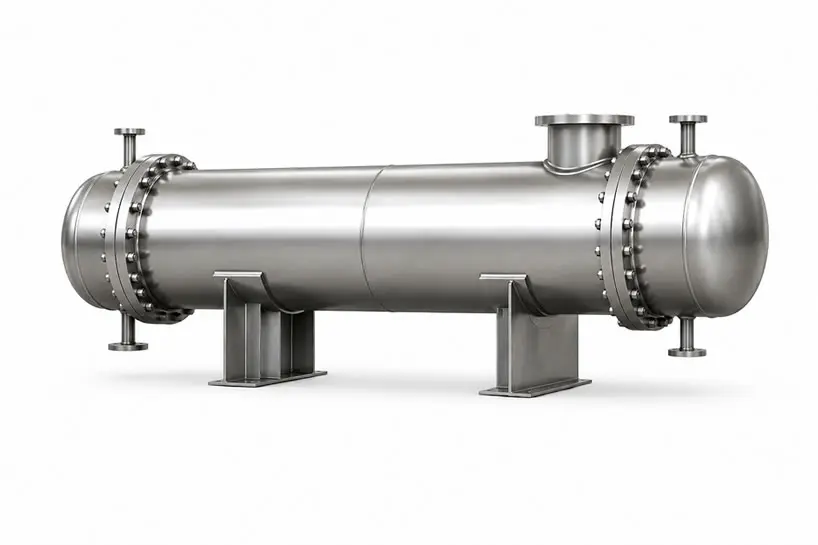
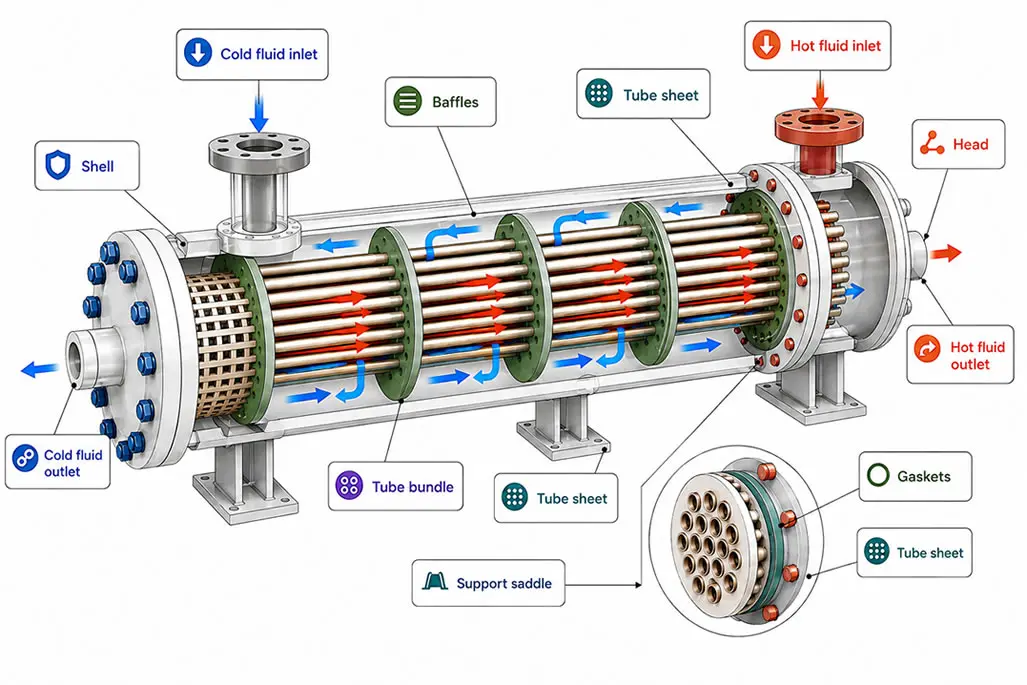
A device that transfers heat between two fluids through tube walls inside a cylindrical shell without mixing the fluids.
2. Which TEMA class should I choose?
TEMA R for refinery and high-pressure service, TEMA B for chemical process industries, and TEMA C for general commercial applications.
3. What causes fouling?
Mineral crystallisation, biological growth, corrosion deposits, suspended solids, and chemical reaction residues accumulating on tube surfaces over time.
4. How long does it last?
A properly maintained shell and tube heat exchanger reliably operates for 20 to 30 years depending on material selection and service conditions.
5. How is it cleaned?
High-pressure water jetting, mechanical rodding, chemical circulation cleaning, or complete bundle removal depending on fouling severity.
Conclusion
Shell-and-tube heat exchangers remain the undisputed choice for industrial heat transfer—engineered to handle extreme pressure, high temperatures, corrosive fluids, and continuous heavy-duty service that no competing design can match reliably over the long term.
From oil refineries and power generation plants to pharmaceutical cleanrooms and marine installations, their proven mechanical strength and operational flexibility make them irreplaceable across every major process industry worldwide.
United Cooling Systems Pvt. Ltd., Coimbatore, manufactures custom shell and tube heat exchangers to TEMA R, B, and C standards—built to deliver 20 to 30 years of dependable performance with minimal maintenance requirements.