


Introduction
A marine heat exchanger is a critical component used to transfer heat efficiently between engine coolant, seawater, fresh water, or other process fluids in marine systems. Designed for demanding offshore and marine environments, shell-and-tube marine heat exchangers provide reliable cooling for marine diesel engines, generators, propulsion systems, lubricating oil, hydraulic systems, and other onboard equipment.
Marine heat exchangers are engineered to withstand continuous operation, seawater corrosion, high temperatures, pressure variations, and challenging operating conditions. In a typical system, hot engine coolant flows through the heat exchanger tubes while seawater passes through the shell side, allowing heat to be transferred without the two fluids mixing.
Core Functions of a Marine Heat Exchanger
Unlike land-based industrial heat exchangers, marine units must contend with constant motion, high humidity, variable water temperatures, and the aggressive chemical nature of raw seawater. Their primary functions include
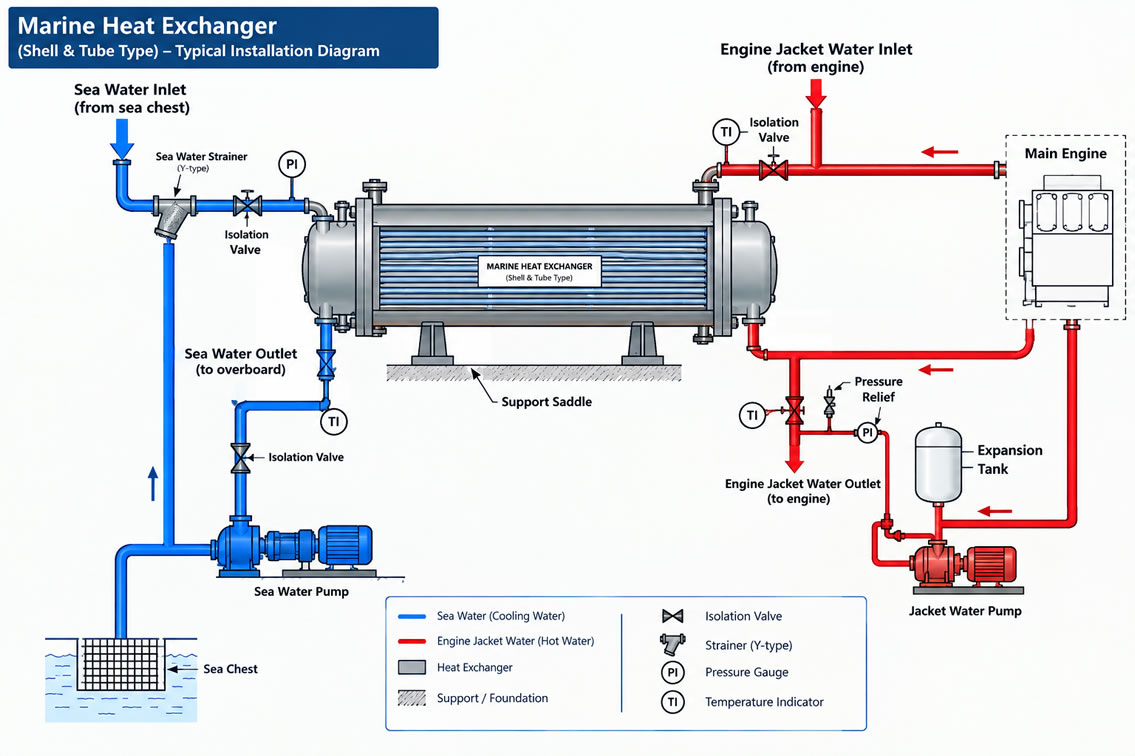
- Engine Jacket Water Cooling—Regulating main propulsion diesel engine temperatures by transferring waste heat into raw seawater or central freshwater cooling loops.
- Lube Oil Cooling—Maintaining optimal viscosity and film strength in heavy machinery lubricating oils.
- Central Cooling Systems—Utilizing central seawater circuits to cool secondary freshwater lines, protecting internal ship piping from direct salt corrosion.
- Marine HVAC & Desalination—Providing climate control across passenger and crew quarters while supporting onboard fresh water generation through evaporation and condensation.
Common Types of Heat Exchangers Used in Modern Vessels
Naval architects and marine engineers typically specify three core configurations depending on space constraints, pressure requirements, and maintenance profiles:
Marine Heat Exchanger Comparison Table
| Feature | Shell & Tube | Plate & Frame | Tube-in-Tube (Coaxial) |
|---|---|---|---|
| Best for | Main propulsion cooling, high-pressure central systems | Compact engine rooms, space-limited vessels | Refrigeration, auxiliary loops, desalination |
| Footprint | Large | Small / compact | Smallest |
| Pressure tolerance | Very high | Moderate to high (gasket-limited) | High |
| Maintenance access | Easy mechanical cleaning | Easy plate removal/addition | Harder to inspect internally |
| Thermal efficiency | Moderate | High | Moderate to high |
| Typical material | Titanium, Cu-Ni, steel | Titanium, stainless steel | Copper, Cu-Ni |
| Upfront cost | Moderate–High | Moderate | Low–Moderate |
| Biofouling resistance | Depends on tube material | Depends on plate material | Moderate |
| Common use case | Main engine jacket water cooling | HVAC, lube oil cooling, retrofit projects | Small refrigeration circuits |
| Lifespan (titanium) | 20–30 years | 15–25 years | 10–20 years |
Shell and Tube Heat Exchangers
The undisputed workhorse of heavy marine engineering. A bundle of metallic tubes is enclosed within a cylindrical shell. One fluid flows through the tubes while the other circulates outside the tubes across internal baffles.
- Best For: Main propulsion cooling, high-pressure central systems, and heavy-duty industrial marine duties.
- Advantages: Exceptional structural robustness, high pressure/temperature tolerance, and ease of mechanical cleaning for larger frame sizes.
Plate and Frame Heat Exchangers
Composed of corrugated metal plates gasketed or brazed together, creating alternative channels for hot and cold fluids.
- Ideal for compact engine rooms with strict limitations on footprint and weight.
- Advantages: High thermal efficiency, exceptional modular flexibility (plates can be added or removed), and a smaller physical footprint than shell-and-tube counterparts.
Tube-in-Tube (Coaxial) Coolers
Featuring one tube concentrically fitted inside a larger tube, directing fluid flow in counter-current directions.
- Best For: Refrigeration, smaller auxiliary cooling loops, and packaged desalination units.
Materials Matter: Combating Seawater Corrosion and Biofouling
The biggest threat to marine thermal infrastructure is the corrosive nature of sodium chloride, combined with biological growth (biofouling). Traditional materials like standard carbon steel or basic stainless steels suffer rapid pitting and crevice corrosion when exposed to stagnant or moving seawater.
Why Titanium Is the Gold Standard
Modern high-performance marine heat exchangers increasingly rely on titanium (grade 2) for tubes and exposed plate surfaces.
- Complete Seawater Immunity —Titanium forms an instant, self-healing oxide layer that prevents chloride-induced pitting, exhibiting virtually zero corrosion even after decades of continuous operation.
- Biofouling Resistance—The smooth passive surface of titanium significantly reduces the adhesion of marine organisms, maintaining steady thermal transfer coefficients over extended deployment windows.
- Lifecycle Economy—While initial capital expenditure for titanium is higher than copper-nickel or standard alloys, its 20-to-30-year operational lifespan eliminates frequent mid-lifecycle bundle replacements, dramatically lowering Total Cost of Ownership (TCO).
Alternative corrosion-resistant options include copper-nickel (90/10) alloys for moderate service conditions and specialized stainless steel grades for closed-loop freshwater circuits.
Key Engineering Challenges & Troubleshooting
Scaling and Fouling
Mineral deposits, silt, and biological slime build up on heat transfer surfaces, choking flow velocity and reducing thermal effectiveness.
- Solution: Implement automated backflushing systems and chemical cleaning CIP (Clean-In-Place) protocols, and maintain recommended fluid velocities (typically above 1.5 m/s in tubes to discourage settling).
- Solution: Proper placement of support baffles in shell-and-tube configurations and adhering strictly to TEMA manufacturing standards.
- Predictive Maintenance & IoT Integration — Fleet operators are deploying smart temperature and pressure sensors across cooling loops to monitor fouling factors in real time, shifting away from scheduled maintenance toward condition-based servicing.
- Alternative Fuel Readiness— As vessels transition toward cleaner maritime fuels like LNG, green methanol, and ammonia hybrids, thermal management architectures must adapt to new cryogenic and high-temperature cooling profiles.
- Compact High-Efficiency Designs— Maximizing heat transfer density while minimizing vessel deadweight to optimize overall fuel efficiency and carbon compliance targets.
Thermal Stress and Vibration
High fluid velocities combined with engine vibrations can cause destructive tube resonance and fatigue failure at the tube sheets.
Future Trends: Smart Marine Thermal Management
The maritime sector is experiencing a profound digital and environmental transformation. Key trends shaping marine heat exchangers include:
Frequently Asked Questions
1. What is the purpose of a maritime heat exchanger?
A marine heat exchanger transfers heat between engine coolant, lube oil, or seawater to regulate temperature in propulsion systems, auxiliary machinery, and onboard HVAC.
2. Which material works best for a maritime heat exchanger?
Titanium (Grade 2) is considered the best material for marine heat exchangers due to its resistance to seawater corrosion and biofouling, though copper-nickel alloys are a lower-cost alternative for moderate service conditions.
3. Shell and tube vs. plate heat exchanger—which is better for marine use?
Shell and tube exchangers are better for high-pressure, heavy-duty main engine cooling, while plate heat exchangers are better for compact engine rooms needing high thermal efficiency in less space.
4. How frequently should a maritime heat exchanger be cleaned?
Cleaning frequency depends on fouling rate and water conditions, but most operators inspect and clean every 6–12 months or switch to condition-based maintenance using fouling sensors.
5. How should a maritime heat exchanger be sized?
Sizing depends on heat load (kW), fluid flow rate, temperature differential, and fouling factor—typically calculated by matching engine heat rejection data to the exchanger's rated thermal capacity.
6. How long does a titanium marine heat exchanger last?
A titanium heat exchanger for marine use typically lasts 20–30 years due to its resistance to pitting and crevice corrosion from chloride exposure.
7. What causes marine heat exchanger failure?
The most common causes are fouling/scaling that reduces flow, tube vibration fatigue from engine resonance, and corrosion from incompatible materials in seawater service.
8. Is titanium worth the extra cost for marine cooling systems?
Yes, titanium's higher upfront cost is justified for long-term operations, as it offers a lifespan of 20–30 years compared to 10–15 years for standard alloys, ultimately lowering the total cost of ownership.
9. What's the difference between central cooling and direct seawater cooling?
Central cooling uses a closed freshwater loop cooled indirectly by seawater to protect internal piping from corrosion, while direct seawater cooling circulates raw seawater straight through engine components.
Conclusion
Selecting the right marine heat exchanger is a critical balance between upfront capital expenditure, material resilience, and long-term operational efficiency. By prioritizing corrosion-resistant metallurgy like titanium, adhering to rigorous design standards, and utilizing modern predictive maintenance practices, vessel operators can secure decades of reliable, trouble-free thermal performance across global oceans.


