

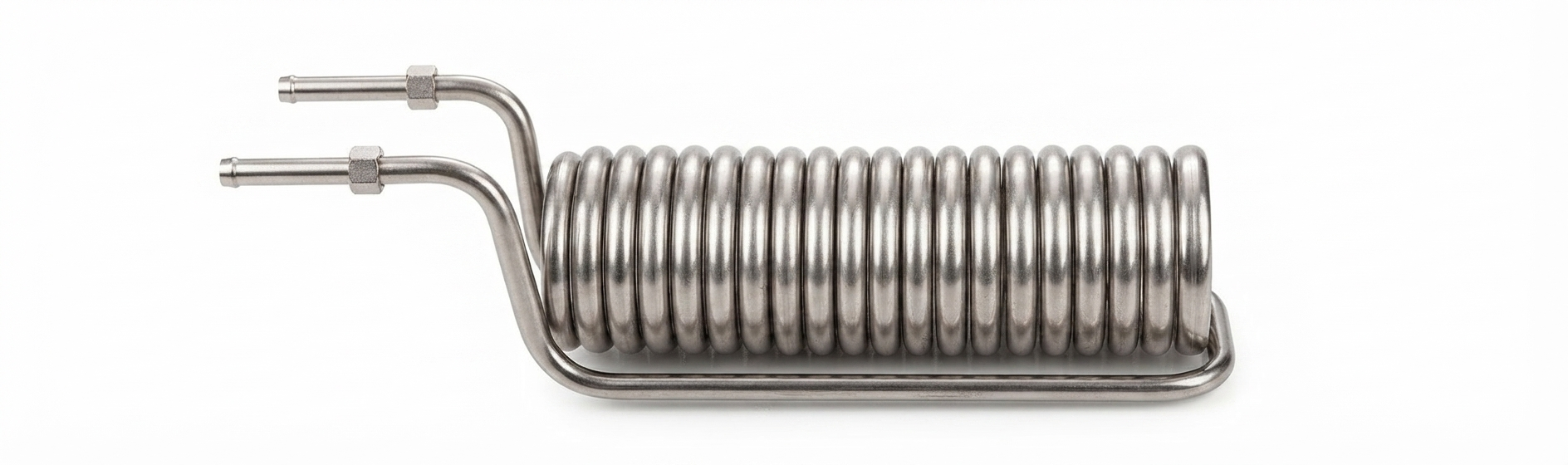
A coil-type heat exchanger is a compact heat transfer device that uses a coiled tube—wound in a spiral or helical shape—to transfer heat between two fluids without letting them mix. One fluid flows through the coiled tube itself, while the second fluid surrounds it, either inside a shell or an open tank, absorbing or releasing heat as it moves across the coil's surface. The winding, extended-length design packs a large heat transfer area into a small physical footprint, making coil-type heat exchangers a practical choice wherever installation space is limited.
United Cooling Systems Pvt. Ltd. manufactures coil-type heat exchangers engineered for process cooling, heating, and condensing duties across chemical processing, HVAC, food and beverage, and industrial utility applications. Built using corrosion-resistant materials and precision-formed coils, each unit is sized to match the exact flow rate, pressure, and thermal load of its intended service, delivering dependable performance and a long operating life.
What Is a Coil Type Heat Exchanger?
A coil-type heat exchanger is a specialized thermal equipment design where one fluid flows through a continuously wound tube (the coil), while a second fluid flows around the outside of the coil within a surrounding shell or jacket. This is due to the fact that it is packed in the fact that it is packed into a compact geometry uses of its geometry.
Key Design Characteristics
The construction of a coil heat exchanger typically includes:
- Coiled Tube Bundle: Formed into helical or spiral configurations using materials like stainless steel, copper, or specialized alloys depending on the fluid corrosiveness.
- Shell / Outer Casing: Houses the coil bundle and directs the flow of the shell-side fluid.
- Inlet and Outlet Ports: To guaranty total segregation, separate connection points are used for the tube-side and shell-side fluids.
- Flexible Geometry: The natural spring-like design of the coil accommodates thermal expansion and contraction seamlessly under extreme temperature fluctuations, minimizing mechanical stress.
Working Principle
The operation relies on convective heat transfer between two fluids at different temperatures separated by the metallic wall of the coiled tube:
- Fluid Entry: The hot fluid enters through one medium (either the tube side or shell side), while the cooling or heating fluid enters through the opposing side in a counter-current or parallel flow arrangement.
- Enhanced Turbulence: As the fluid moves through the curved or helical path of the coiled tube, centrifugal forces and secondary flows are generated. This induces high fluid turbulence even at lower flow velocities.
- Thermal Transfer: Because of the enhanced turbulence and high surface-area-to-volume ratio, thermal energy transfers rapidly across the tube walls from the hot fluid to the cold fluid.
- Fluid Exit: The cooled/heated fluid exits via its designated outlet port, ready for industrial processing or recirculation.


